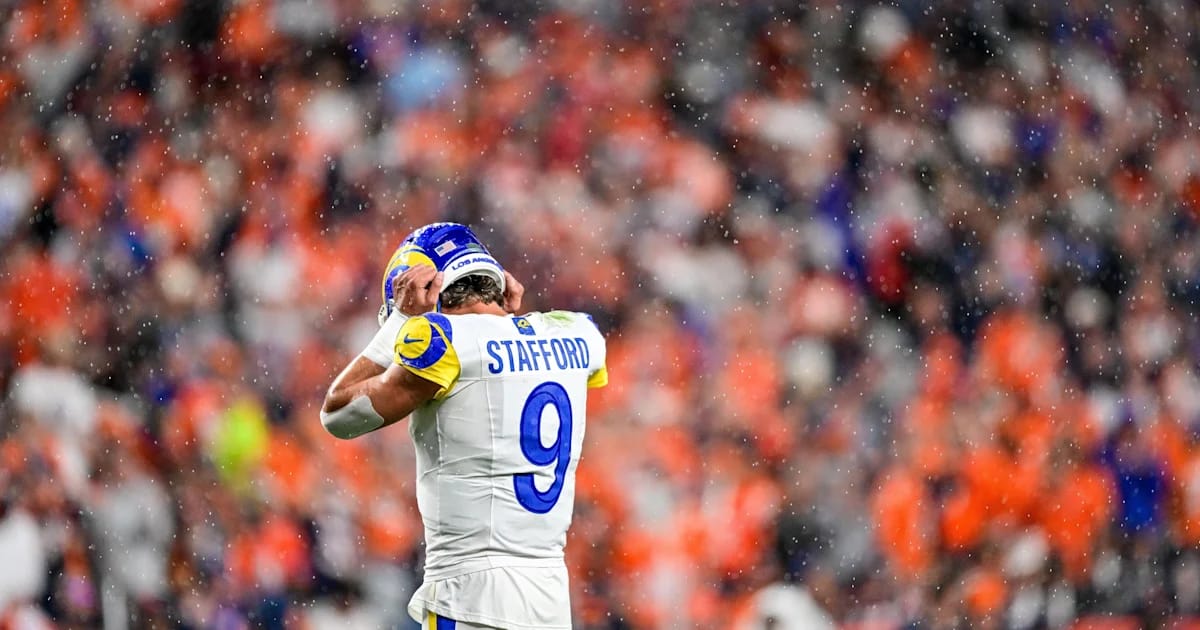
One could try to falsely blame the Los Angeles Rams’ 1-2 start on either injuries or officiating. The real reason for LA’s shortcomings is the fact that their key players are not performing at star levels.
Matthew Stafford has truly been one of the worst quarterbacks in football right now. He is certainly better than that and will likely rebound at some point. Colby Parkinson is on a milk carton instead of the box score. The offensive line generally retreats in pass protection. Kobie Turner, Braden Fiske, Byron Young, and even Aaron Donald failed on the defensive line. Nate Landman still hasn’t found his early season magic from a year ago.
Advertisement
For now, let’s focus on the Rams’ anemic passing attack.
The theme of the 2026 NFL season is that defenses aim to take limits on explosives and force opposing offenses to stay patient and survive short passes. This quote from Ted Nguyen at The Athletic helps set the scene.
Offenses have been loaded with bigger bodies this offseason and seem to be preparing to focus more on the running game, but can they force defenses to go back to putting the safety in the box? After talking to the defensive coaches, the collective answer was, surprisingly, no. Two-high defense is here to stay. Quarterbacks and receivers are very good. Finding ways to slow down the run, while making it difficult to make explosive pass plays, is the key to modern defenses. Even if one or two teams become so explosive on the ground that they force defenses to put extra safeties in the box, those offenses won’t be enough to change the defensive meta…
According to defensive coaches, the evolution will continue with defenses finding ways to slow down the run game with light boxes, confusing the quarterback and devising ways to attack defensive schemes. Putting an extra safety in the box just creates too much danger for defenses for the league to go back in that direction.
Pete Prisco from CBS Sports took this analysis further. Offenses put together longer drives. That takes more time on the clock. Ultimately, each team has fewer possessions, fewer chances to score, and the margin between winning and losing has never been tighter:
What the hell happened to the NFL passing game?
This is a league that once saw 5,000-yard passers, big numbers downfield, quarterbacks who let it fly, and coaches who weren’t afraid to let them do it. But last year, the average passing yards per game for NFL teams was the lowest since 2008…
Think about it: NFL teams averaged just 209.7 passing yards per game last season, and just 10 years before that, teams averaged 243.8 yards per game. That’s a big drop. In 2015, the league averaged 10.8 yards per catch. Last season, it was 10.2…
That spreads throughout the league. Be patient with offenses and make them drive down the field. Fans love big plays. Offensive coaches and players do too, but getting them now mostly means yards after the catch instead of the ball in the air.
What specifically happened to the Rams?
As Prisco pointed out, yards after the catch are at a premium. LA’s best YAC receiver, Puka Nacua, has missed two of three games. Terrance Ferguson is probably their next best pass catcher in this facet, and he was a nonfactor in Week 1 before exiting early in the third game. Nacua could be back in Week 4 but Ferguson likely won’t be back in time.
Advertisement
Davante Adams is somehow 11th in the NFL in YAC with 105 yards after the catch point. It’s not necessarily something you’d expect him to do well, but again it’s endlessly impressive that Travis Kelce leads all players with 155 yards. Part of Adams’ success is volume. He is 10th in receptions, fifth in targets, and 26th in YAC/reception among all players with at least 17 targets.
And then there’s the quarterback and play caller.
One thing is certain about Sean McVay and Matthew Stafford: both love long, vertical throws and capitalize on explosive plays. Neither has historically shown much ability for the short passing game. It’s not how they want to play, generally.
But 43.2% of Stafford’s attempts have come within 0-9 yards this season. That ranks 22nd out of 36 quarterbacks who meet the qualifying 20% target threshold. On such plays, Stafford ranks 32nd in Pro Football Focus (PFF) passing grade.
Advertisement
Stafford completed 37 of 48 passes (77.1%) for 320 yards, 2 TDs, 1 INT, 0 big-time throws, and 2 turnover-worthy plays in this category. LA’s signal caller was ninth in attempts between zero and nine yards. He was 11th on first down. His average depth of target of 3.9 yards on such plays ranks him 30th among this group, so when Stafford is short it’s usually very short.
More telling is that the company is in the same range as his with those at the top of the list.
Towards the bottom:
Bo Nix (26th; 60.3) – has rebounded dramatically from last season
Malik Willis (27th; 58.0) – not yet a solid starter
Jordan Love (28th; 57.0) – one of the most disappointing players in 2026
Jalen Hurts (30th; 54.1) – in a new offense and struggling
Matthew Stafford (32nd; 53.5)
Joe Burrow (33rd; 52.7) – won but didn’t light up the scoreboard
Sam Darnold (34th; 49.3) – struggled in first game back from injury
Above:
Drew Lock (6th; 81.2) – got big money in the offseason
At the risk of oversimplifying, those who excel in the short passing game are best suited to succeed in today’s NFL. Defenses want quarterbacks to live and die by the deep ball. Those who can repeatedly take what the opposition gives them without getting impatient will prevail.
Advertisement
The short passing game has never been the Rams’ strength or bread and butter under Sean McVay. This is something that needs to be improved in order for LA’s passing game to right the ship. We will continue to measure progress and review this trend as we collect more information.