Close to Current Best Ball Market
150 Puppies. 15 Best Ball Manias. All slow drafts. Together together.
That’s how I started Best Ball Summer at Underdog.
I’ve been playing best ball since DRAFT was a thing, but this marks my first foray into the 2024 market. What I thought would be one of the more +EV spots of the summer (maxing out the Puppy after the schedule was released) quickly started to feel like lighting $750 on fire as I went through five stages of grief in the inflated WR market. The resulting bargain-bin RB market only added to the confusion.
Bijan Robinson and Breece Hall in the back half of Round 1? A few years ago, they probably had ADPs of second and third overall.
Saquon Barkley, Derrick Henry, and Josh Jacobs who are now in good offenses go in the second, third, and fourth rounds, respectively.
Young talents in good situations like Isiah Pacheco, James Cook, and Kenneth Walker went right after that.
How to Manage a WR-Crazy Draft Room
I use a lot of different draft strategies, and the Zero RB is one of my favorites. But each round seems to show more RB value than the last as talented backs fall and questionable WRs move up draft boards.
We have never seen a market like this before. The general discourse seems to be: Keep drafting WRs early and often or you’re doomed.
But everything we learn about what works in the best balls is still from small sample size data in different markets.
I can’t help but feel that we are very confident that the current market is doing well. I started thinking: “What will the 2025 best football articles look like?”
Optimizer to the Rescue!
I watched a 2022 interview with DFS legend “nerdytenor” on the ultimate best ball strategy. He mentioned that his tournament best ball strategy is finding the optimal lineup and matching exposures to them as much as possible.
And from there, this idea was born. Take Draft Sharks’ industry-leading ceiling projections and run them through an optimizer to see which players pop up the most to figure out what’s best in this current market.
With a little help, I built that optimizer and I’ve made over 6,000 lineups.
I ran every player with ADP in BBM V through an optimizer 6000+ times @SmolaDS ‘s #1 ranked (ceiling) projection
Here are your top 25 in order of % appearance
Warnings and top QB, RB, WR, TE pic.twitter.com/bKPGTy8LUR
— Steve Myette (@in3usDFS) June 6, 2024
What You Should Know About Optimizer
But before we get into the results, let’s talk about the limitations of the optimizer and this study to provide some important context.
What the optimizer does really well is exactly what an optimizer sets out to do in its most basic form: Create an optimal lineup based on the projections it’s fed. There are two important constraints:
- It selects one player per round based on their ADP
- This follows common-sense roster construction (in this iteration: 2-3 QB, 4-6 RB, 7-9 WR, and 2-3 TE).
However, the optimizer also has some limitations that affect the results:
- Ceiling projections typically do not account for contingent increasesa pillar of the Zero RB strategy. This will naturally skew optimal picks in the later rounds towards WR when RBs can be better picked based on ceilings that are not accounted for by projection systems.
- The optimizer looks at the cumulative score (so it doesn’t optimize for Week 17 or weekly scoring) and it does not consider the draft capital. It has both positives and negatives. On the positive side, the optimizer is unaware of the current market “meta” and avoids the potential pitfalls in roster development associated with it. Alternatively, the optimizer doesn’t know how many of each position we’ll start in a week, so when the optimizer spat out the first 5 lineups that we drafted both Travis Kelce and Mark Andrews, I noticed the process wasn’t perfect. While I love both guys this year in the depressed elite TE market, I’m pretty confident having them on the same team when we almost always only have one starter each week isn’t worth it. That’s why the study looks at the appearances of individual players in the outputs and not the individual best teams.
- The optimizer does not force any stacking to not skew individual player values by forcing a suboptimal player in the pool to complete a stack.
- Setting ADP ranges by rotation and not by selection makes some players stronger with ADPs in the front rounds and offending some players with ADPs behind a round, especially in the earlier rounds where the ADP is better. This does not mean these players should not be drafted. (My sincerest apologies to Jaylen Waddle and his 23.6 ADP at the time the optimizer was run for this article.)
What the Optimizer Teaches Us
OK, now we’re ready for some results. For those just interested in the data or player acquisitions, I’ve uploaded the output to a Google Sheet that I’ll update throughout the summer as ADP and projections change.
So what conclusions, if any, can we draw from what the optimizer says is best in the 2024 market?
To quantify that at the draft-capital level and roster-construction at the individual player level, I aggregated the results into six buckets (Rounds 1-3, 4-6, etc.) and looked at the percentage the optimizer released by position.
For example, the optimizer suggests that we typically pick two RBs and one WR in the first three rounds. The suggestion for rounds 4-6 is a RB, a TE (Travis Kelce or Mark Andrews), and probably a WR over a QB.
I’m still not convinced how much weight to put on these results. We know the market. We know we use some of the best projections available. We know we’re building rosters with positional allocations that make sense.
We are also aware of the drawbacks, mainly that this practice is inherently biased against Zero RB.
So it’s not surprising to see results with RB early and WR late.
But are the results significant?
There is a reason why the hyper-fragile approach to RB exists.
Underdog’s own Hayden Winks showed that RB-RB started working on BBMI and II. Pat Kerrane fired the BBMIII in a RB-RB start. The data hasn’t been very promising lately, but we still haven’t seen a market like this.
This next visual further contextualizes the new gap we see between RBs and WRs.

We can see that RBs are projected to outperform WRs at their ceiling at every stage of the draft up until the range of Round 7 or 8. I even adjusted this for PPR scoring and RBs still came out ahead (although the gap was narrower).
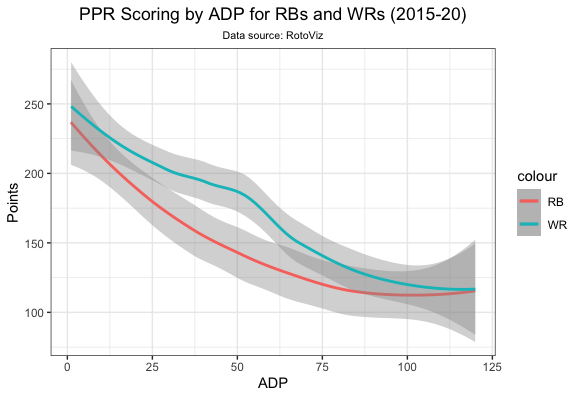
However, these market projections are far from the actual points we’ve seen these positions score in past ADPs. See the graphic below from a 2021 article by Establish the Run’s Jack Miller, the most recent comparable data I could find.
WRs have historically outperformed RBs at every stage of the draft. If we trust the Draft Sharks projections (and we probably should), that won’t be the case in 2024.
Perhaps the question we should be asking ourselves now is not “can I get enough RBs later?”, but “can I get enough WRs early?”
What Does This Mean for 2024 Best Ball Draft Strategy?
Having said all that, as the author of this article, I went into this without an agenda and I remain cautious.
These are not the test answers. They are just one piece of the puzzle. I’m still afraid not to lean into this WR-heavy market.
We know it was inefficient before, especially when it comes to rookies. Now the question is whether we overcorrected. I will still be using a lot of Zero RB and Hero RB builds this summer.
I’m also convinced that in a market that prioritizes WRs as much as it does, there’s still some validity to mixing in hyper-fragile RB builds – and, perhaps in the hungriest WR room (gulps), solid RB builds.
But what if we create too much division at both extremes in RB bro vs. WR bro holy war?
More recently, Pat Kerrane pointed out the drawbacks to hyper-fragile drafting while Pete Overzet also did the Zero RB. The issues are the same. Extreme draft strategies on both ends lock you into a position early, limiting flexibility and opportunities for value later in the draft.
TIP
Staying flexible and capitalizing on ADP value is a key tenet of an optimal best ball strategy.
As with many things, the answer is probably somewhere in the middle.
We all know the mantra of “letting the draft come to you.” The current market shows that. I don’t think we should be afraid of these WR prices and we can’t afford to get caught in the position. But we still haven’t seen quality RBs at such a discount and shouldn’t be afraid to pick them up either.
So now I’m also going to mix in a more balanced approach of WR-heavy starts followed by targeting RBs in a dead zone that now feels alive.
Perhaps the title of this article in 2025 will be “Everything in Moderation.”
Ready to Draft Your Best Ball Team?
Boost your chances of winning with the most powerful draft tool on the market. Watch the video below to learn more.