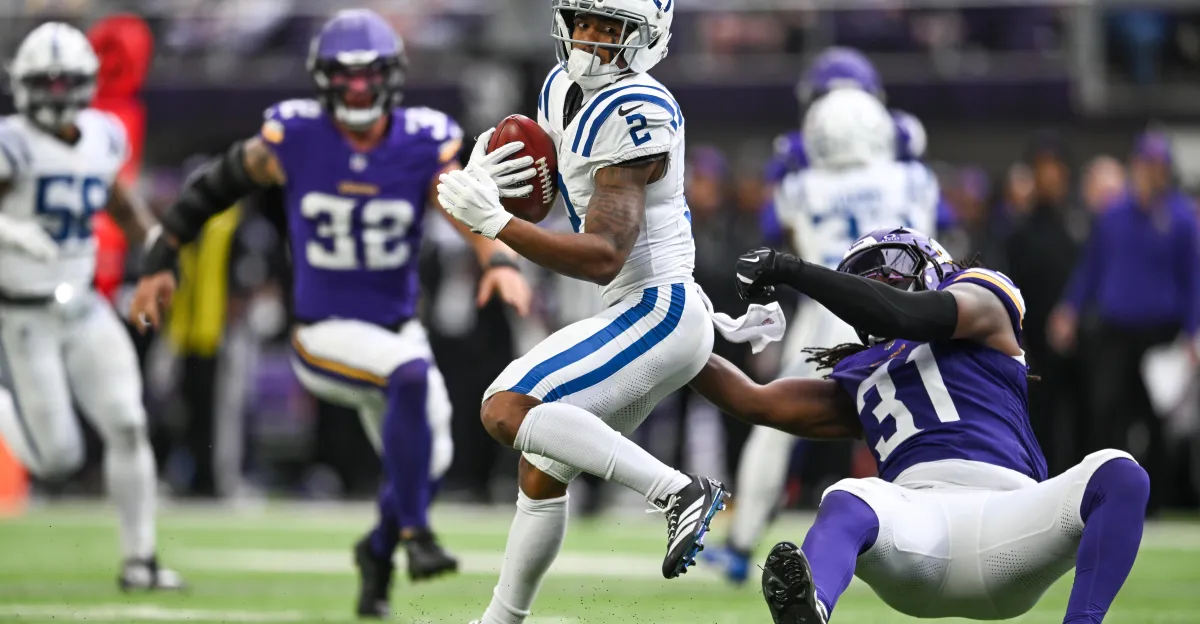
What started as a hypothetical examination of the trade value of three of the Indianapolis Colts’ biggest stars has quickly become reality. Over the past week, I evaluated the potential returns for Jonathan Taylor, DeForest Buckner and Quenton Nelson. Since then, Indianapolis has traded both Buckner and Nelson, receiving almost exactly the compensation I projected for each player. With the organization seemingly embracing a rebuilding approach following the dismissal of general manager Chris Ballard, attention is now shifting toward which players could be next.
According to ESPN’s Jeremy Fowler, wide receiver Josh Downs has requested a trade from Indianapolis, with multiple teams reportedly expressing interest ahead of the November 10 deadline. Downs did not directly confirm the report when speaking with reporters Wednesday, although he acknowledged being open to whatever happens. Unlike Buckner and Nelson, Downs is only 25 years old and should be entering the most productive stretch of his career, making his potential departure somewhat more surprising. However, with his rookie contract expiring after this season and the Colts potentially facing several years of organizational uncertainty, there is a reasonable argument for moving him if another team makes a worthwhile offer.
Since being selected in the third round of the 2023 NFL Draft, Downs has quietly developed into one of Indianapolis’ most dependable offensive players. As a rookie, he recorded 68 receptions for 771 yards and two touchdowns, establishing himself as a reliable target despite the Colts dealing with considerable uncertainty at quarterback. He followed that up with an even better sophomore campaign, catching 72 passes for 803 yards and five touchdowns in just 14 games. His production declined somewhat in 2025, when he finished with 58 receptions for 566 yards and four touchdowns, although he remained an important part of the passing game. Through seven games this season, Downs leads the Colts with 307 receiving yards on 26 receptions, despite the offense’s continued struggles with Daniel Jones at quarterback.
At 5-foot-9 and approximately 170 pounds, Downs is not the type of receiver who will consistently overpower defensive backs or dominate contested catches, but his quickness, route running and understanding of defensive coverages make him extremely effective in the slot. He has demonstrated an impressive ability to create separation in tight spaces, find openings against zone coverage and provide quarterbacks with a dependable target on third down. His acceleration also allows him to turn relatively routine completions into meaningful gains, making him valuable to an offense that has struggled to generate consistent passing production.
However, there is a distinction between being a very good slot receiver and a legitimate No. 1 or No. 2 receiving option capable of producing regardless of the surrounding circumstances. Downs has never surpassed 1,000 receiving yards in a season, and while Indianapolis’ quarterback instability has undoubtedly influenced his production, teams will have to evaluate whether he can take on a substantially larger role in another offense. His ability to consistently move the chains should make him attractive to contenders, but his relatively modest statistical ceiling and primarily slot-based role could limit the compensation teams are willing to surrender.
Two recent receiver trades provide excellent comparisons
There are two recent trades that provide a particularly useful framework for evaluating Downs, beginning with Jakobi Meyers, whom the Las Vegas Raiders traded to the Jacksonville Jaguars at the 2025 deadline in exchange for fourth- and sixth-round selections in the 2026 NFL Draft.
Meyers was 28 years old at the time and coming off the best season of his career, recording 87 receptions for 1,027 yards in 2024. He had also developed a reputation as one of the league’s more dependable possession receivers, consistently producing between 700 and 900 yards throughout his career. However, he was entering the final months of his contract and had requested a trade from Las Vegas earlier that year. Jacksonville needed another reliable target following injuries to several members of its receiving corps, and despite Meyers’ established track record, the Raiders received only a fourth- and sixth-round pick.
Downs shares several similarities with Meyers in terms of how he operates within an offense, particularly his ability to create separation underneath and provide a reliable option on third down. His biggest advantage is his age, as he is three years younger than Meyers was at the time of that trade, potentially giving an acquiring team several more seasons of productive football. However, Meyers had already demonstrated that he could produce a 1,000-yard season and possessed a much longer history of consistent production. While Downs might have more untapped potential, it would be difficult to argue that he has already established himself as the better receiver.
The second comparison involves Rashid Shaheed, whom the New Orleans Saints traded to the Seattle Seahawks during that same 2025 deadline period. Seattle surrendered fourth- and fifth-round picks in the 2026 draft to acquire Shaheed, who was 27 years old and had recorded 44 receptions for 499 yards and two touchdowns through nine games. Unlike Meyers, Shaheed brought a much different skill set to the table, with his exceptional speed, ability to stretch the field and contributions as a return specialist making him particularly attractive to contenders. A former All-Pro punt returner, he provided Seattle with a legitimate deep threat while immediately strengthening its special teams.
Downs is arguably the more complete receiver when it comes to working underneath, running precise routes and consistently moving the chains, although he does not possess Shaheed’s game-breaking speed or special teams value. Both players offer something different, and their strengths would appeal to teams with different offensive needs. Downs is younger and could develop into a more consistent receiving contributor, but Shaheed’s explosiveness gave Seattle a dimension that is difficult to find, particularly in the middle of a season. So while they were different players, they were both similar in how their skillsets limited their overall value.
What makes these comparisons especially relevant is that neither player commanded a third-round selection despite being an established NFL contributor. Meyers had considerably more career production than Downs, while Shaheed offered a unique combination of receiving and return ability that made him attractive to a contender. Both were also approaching unrestricted free agency, meaning the acquiring teams were accepting the possibility of losing them after only a few months. Their respective returns suggest that the market for Downs should begin somewhere around a fourth-round pick, with the potential for additional compensation depending on how many teams become seriously interested.
His contract makes him an affordable short-term addition
Downs is currently playing out the final season of his four-year rookie contract, which expires following the 2026 season. His cap hit this year is approximately $4.18 million, including a base salary of $3.92 million, meaning an acquiring team would only be responsible for the remaining portion of that salary after a trade. For a contender operating with limited cap flexibility, adding an established receiver at a relatively modest financial cost could be particularly appealing, especially when compared with some of the more expensive veterans who might become available.
However, the more significant consideration is what happens after the season. At 25 years old, Downs will likely be looking for his first major contract extension, and the wide receiver market has become increasingly expensive over the past several seasons. Even players who are not considered legitimate No. 1 options have secured substantial multiyear contracts, and Downs could reasonably expect to pursue a similar deal given his age and consistent production. Any team acquiring him would therefore have to decide whether it intends to negotiate an extension or simply use him as a short-term addition for a potential playoff run.
That uncertainty creates a dilemma for Indianapolis as well. Downs is exactly the type of young player a rebuilding organization would ordinarily want to retain, particularly when preparing to develop another quarterback. However, if his reported trade request reflects a genuine desire to leave and he has little interest in signing an extension, keeping him for the final months of a disappointing season becomes considerably harder to justify. The Colts could potentially receive compensatory draft capital if he departs in free agency, but that would depend on the contract he signs elsewhere and Indianapolis’ own offseason activity. Any compensatory selection would also arrive in 2028, making a guaranteed pick in 2027 an attractive alternative.
How much productive football does Downs have left?
Unlike the other players examined in this series, Downs is young enough that his best football could still be ahead of him. At 25, he could realistically provide another five or six productive seasons, particularly given that his style of play relies heavily on route running, quickness and understanding defensive coverages rather than simply overpowering opponents. Those are qualities that can remain effective as receivers approach their late 20s and early 30s, giving an acquiring team some confidence that Downs could become a long-term contributor rather than merely a temporary addition.
There is also reason to believe his statistical production could improve considerably in a more stable offensive environment. Throughout his career in Indianapolis, Downs has dealt with frequent quarterback changes and inconsistent passing attacks, often limiting his opportunities despite demonstrating the ability to create separation. A move to an offense with an established quarterback and a more reliable passing game could allow him to approach or potentially surpass 1,000 receiving yards, especially if he receives a larger share of the targets. That projection is far from guaranteed, but his underlying ability suggests there may be more production available than his career numbers currently indicate.
The challenge for interested teams is determining how much they should pay for that potential. Downs has established himself as a productive NFL receiver, but he has not yet demonstrated the ability to consistently carry a passing attack or command the attention of opposing defenses as a primary target. His age and remaining upside should strengthen his market, although teams are unlikely to surrender premium draft capital based solely on what he might accomplish in a different situation.
Which teams could be interested?
There should be a reasonably healthy market for Downs, particularly given his age and affordable remaining salary. Pittsburgh is one of the more interesting possibilities, with NFL insider Jordan Schultz reporting that the Steelers are among several AFC teams that have expressed interest. The Steelers have dealt with injuries at wide receiver and could benefit from adding a dependable target underneath, particularly someone capable of consistently creating separation and moving the chains. Downs would provide a different skill set from some of their bigger receiving options, while potentially reuniting with former Colts teammate Michael Pittman Jr., whom Pittsburgh acquired earlier this year.
Kansas City is another team that could make sense, especially given the Chiefs’ continued desire to surround Patrick Mahomes with reliable receiving options. Downs’ ability to work effectively from the slot and find openings against zone coverage could fit well within Andy Reid’s offense, where receivers are frequently asked to understand complex route combinations and create separation in tight spaces. He would not necessarily transform the offense by himself, but his consistency underneath could provide Mahomes with another dependable target while allowing the team’s more explosive players to operate elsewhere on the field.
New England also presents an intriguing possibility because of Downs’ previous connection with quarterback Drake Maye at North Carolina. The Patriots have invested heavily in supporting their young quarterback, and bringing in a receiver who already has experience working with him could provide immediate benefits. Downs would offer another reliable presence in the middle of the field while potentially becoming a longer-term piece of an offense built around Maye. His age makes him a particularly appealing option for a team that could be interested in keeping him beyond this season.
While those are only a few potential destinations, the reported interest from multiple teams could work in Indianapolis’ favour. Downs is young enough to appeal to organizations thinking beyond the current season, while his relatively inexpensive remaining contract makes him accessible to contenders looking for immediate help. If several teams believe he could become a long-term contributor, the Colts might be able to generate a competitive market that pushes his return slightly above what the historical comparisons would otherwise suggest.
So, what is Josh Downs actually worth?
Downs presents an interesting trade scenario because he offers considerably more long-term upside than the typical veteran available at the deadline. He is only 25 years old, has already demonstrated that he can be a productive NFL receiver and could reasonably develop into an even better player in a more stable offensive environment. However, the recent trades involving Meyers and Shaheed provide a fairly clear indication of what teams have been willing to surrender for established receivers approaching free agency.
Meyers was a more accomplished receiver who had already surpassed 1,000 yards in a season, yet Las Vegas received only fourth- and sixth-round selections. Shaheed offered one of the league’s more explosive receiving and return combinations, but New Orleans received only fourth- and fifth-round picks. Downs’ younger age provides an advantage over both players, although his lack of high-end production and primarily slot-based role make it difficult to justify substantially greater compensation. A third-round pick is certainly possible if several contenders become involved, but I would consider that an excellent outcome rather than the most likely return.
My valuation would be a 2027 fourth-round pick and a 2028 fifth-round pick.
That package would give Indianapolis two selections for a player it could otherwise lose in free agency, while acknowledging the relatively modest market established by the Meyers and Shaheed trades. It would also fall slightly below the compensation Seattle surrendered for Shaheed when accounting for the additional year of waiting for the fifth-round selection. Given Downs’ age, the Colts should not be particularly eager to move him for anything less, especially since replacing a productive young receiver would create another position of need for the next general manager.
However, his reported trade request changes the equation considerably. If Downs has already decided that his future lies elsewhere, Indianapolis would be taking a substantial risk by keeping him through the remainder of the season and potentially losing him without guaranteed compensation. The Colts have already demonstrated their willingness to move established players, and Downs could be the next name added to that list. A fourth-round pick and a future fifth might not sound particularly exciting for a talented 25-year-old receiver, but considering his contractual situation and the recent trade market, I believe that would represent a fair and realistic return for Indianapolis.