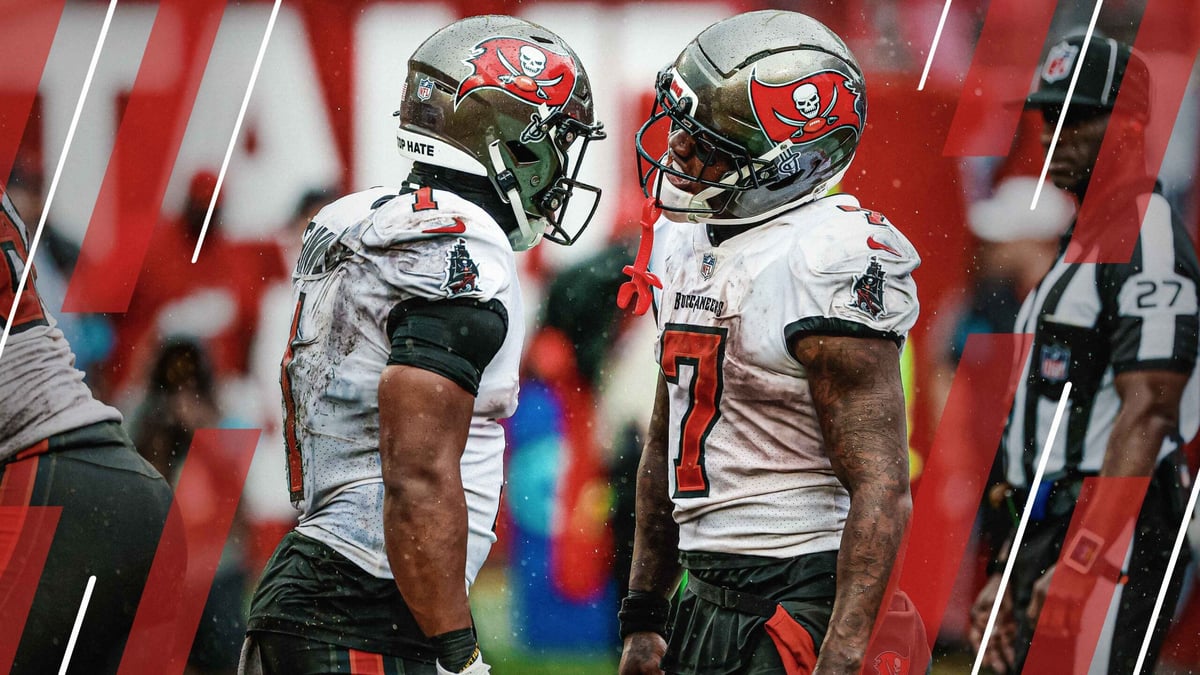
- Buccaneers turn back the clock: Tampa Bay became the first team since 1973 to win two straight games attempting 11 or fewer passes in each.
- Bucky Irving and Kenneth Gainwell played their part: The pair both rank inside the top 12 in PFF rushing grade, fueling an attack that thrives after contact.
- An unpredictable but effective technique: The Buccaneers have seen strong results using anything from out of zone to man to counter concepts.
The premise of winning a football game in the modern era without completing a single pass sounds more like a video game challenge than something that could be attempted, let alone completed, in real life. Ask any football player, coach, statistical analyst or even fan, and the paths to success without a pass being caught are nearly impossible.
And yet, the Tampa Bay Buccaneers pulled off exactly that in their 16-0 victory over the Atlanta Falcons on Sunday. In Week 8, Tampa became the first team since 1974 to win without completions — representing a remarkable feat that defies mainstream understanding.
In his second game back from a dislocated thumb, quarterback Baker Mayfield dropped just seven times all day. He threw three passes — one of which was considered a big-time throw on a beautiful backshoulder deep ball to rookie Ted Hurst — and another of which was a dropped screen. Consider that the Buccaneers are not even call a pass after the 9:37 mark of the third quarter!
The weather almost certainly played a role in Tampa’s offensive game planning and in-game adjustments; after all, the ball slipped through the hands of Mayfield and other players many times. But more importantly, this type of offensive structure underscores a commitment to a dominant running game, which Tampa has continued to establish throughout the season.
Week 8 was the piece de resistance for the Buccaneers. The team compiled a whopping 324 rushing yards on 56 carries, ripped off 10 explosives and forced 16 missed tackles. Tailbacks Bucky Irving and Kenneth Gainwell both earned at least a 78.0 PFF rushing grade and averaged at least 4.12 yards after contact per carry.
It’s hard to pinpoint one particular aspect of Tampa’s relentless ground attack, but what particularly stands out is the individual work done by its tandem. In fact, Irving and Gainwell combined for 229 yards after contact, the second-most by a team in a game this year. That performance followed a 222-extra-yard performance in Week 5 as well, marking the fourth-highest total in 2026.
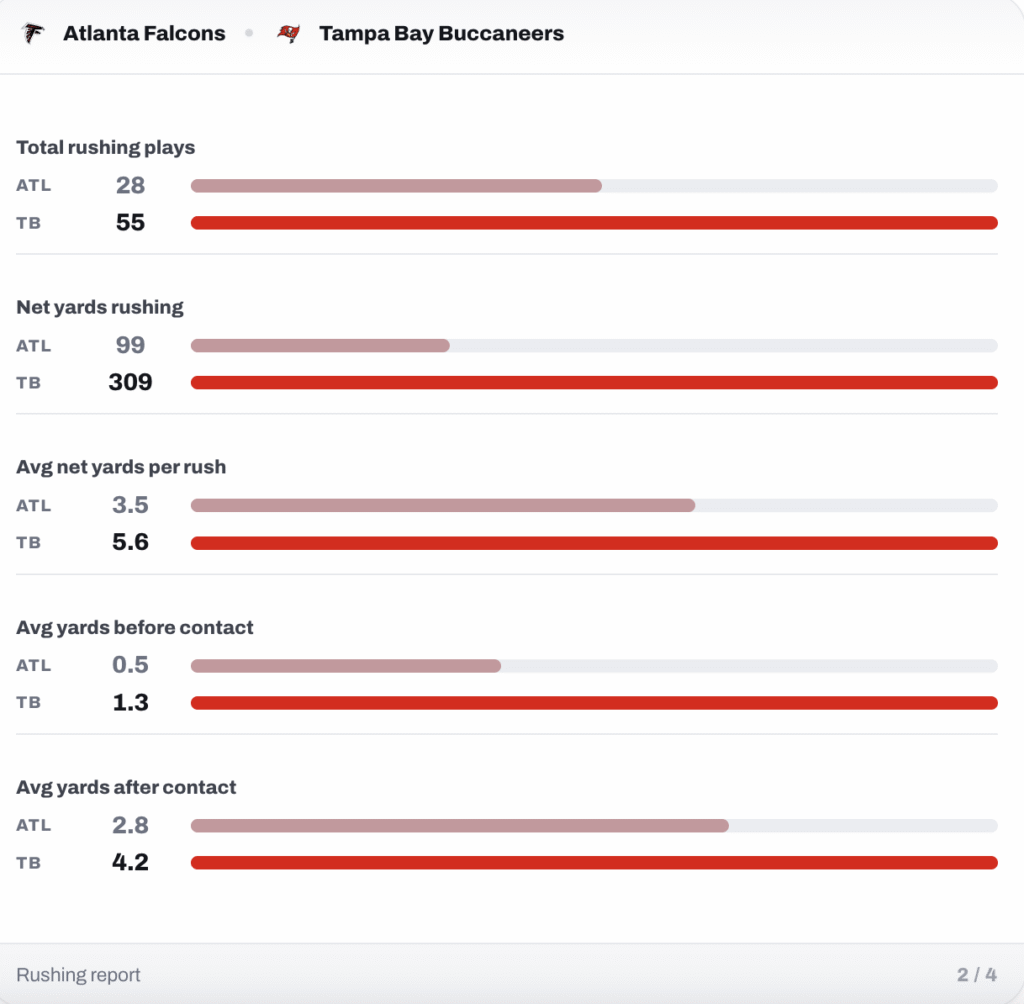
Putting together this kind of one-dimensional day speaks to not only a true commitment, but also to the player’s tireless effort. The hard running of Irving and Gainwell, along with the team’s blocking and technique, underpins what has been a defining aspect of the Buccaneers’ midseason resurgence.
Heading into Week 7, Todd Bowles’ team sits at 1-5 and is on the clear outside looking at an improbable NFC South race. But that Sunday against the Panthers marked the beginning of an unrelenting message: Run the ball, almost anything.
Over the past two weeks, Tampa Bay has rushed 102 times. That number is nearly 30 more carries than the second-place Lions, along with the most two-game mark of any team this season.
That switch-flipping paid off big. Since Week 7, the Buccaneers are fifth in rushing EPA per game and sixth in success rate. They got 18 explosive carries, the most of any squad in a two-game window since the Bears from Sunday 8-9, 2022.
A broader sample of the season similarly paints the Buccaneers’ rushing attack as particularly potent with the ball in the hands of Irving and Gainwell. Tampa rushers forced 51 missed tackles, the third-most of the Lions and Chiefs. Furthermore, the Bucs’ 3.7 yards after contact per rush trail only the Falcons.
Among the 38 backs with 55 or more carries, Gainwell and Irving both rank in the top 12 in PFF rushing grade (pending Week 8 final review), the only teammates to accomplish that feat. The pair are also among the top seven running backs in yards after contact per attempt, and have each forced at least 16 missed tackles. Simply put, the Buccaneers have one of the best one-two punches in the sport that wears down defenses for 60 minutes.
Another impressive layer to what that tandem has accomplished is that the Buccaneers’ run-blocking unit hasn’t been too dominant. While Tampa compiled 124 rushing yards prior to contact against Carolina in Week 7, the team was tied for 15th in overall yards before contact per carry (1.1). Plus, the Bucs are 15th in the collective PFF run-blocking grade, with tackles Tristan Wirfs and Luke Goedeke the only players above a 70.0 grade in 50-plus run-blocking snaps.
Much of a rushing attack comes from either the effectiveness of blocks or the efforts of players once they receive the ball. But in Tampa Bay’s case, a deeper dive under the hood also explains what has been a creatively successful scheme.
This season, new offensive coordinator Zac Robinson has relied primarily on outside zones, deploying concepts 34% of the time. However, Robinson also mixed in a fair share of man and counter looks, each representing at least 19% of run plays. That difference may not seem significant, but the Buccaneers are one of six teams with at least a 19% run rate in three separate concepts in 2026.
Whichever button Robinson pushes, the results are likely to be favorable.
Buccaneers run draft frequencies and rankings, 2026
Having two separate but effective runners also allows Robinson to maximize his chances. For example, Irving is the league’s highest-rated runner on the counter, while Gainwell is third in the outside zone. While using a concept more often than just one runner can create a bit of familiarity, this kind of versatility is also a major asset for keeping defenses honest and respecting the full spectrum of options.
With their efficient and explosive run game, coupled with a stingy, blitz-heavy defense, the Buccaneers have climbed into second place in the NFC South race — holding a valuable 2-0 divisional advantage. A season that looked like a death knell for Bowles, including a potential sale of assets at the trade deadline, has been revived to the point of likely winning the division for the fifth time in six seasons.
The overall question for the Buccaneers is how long they can sustain this unique formula. After all, the Bucs are only the third team since 1970 to win two straight games while trying 11 or fewer passes each, joining the 1973 Bills and 1972 Bears. In case you were curious, none of those teams even made the playoffs.
Tampa Bay’s offensive principles will be tested in a big way starting in Week 9 when it faces a powerful Bears team on Sunday night. A similar challenge awaits against the mighty Lions in Week 11.
It’s highly unlikely the Buccaneers can employ a similar run-pass split and score enough points to match the juggernauts, meaning Mayfield — who owns just a 60.6 PFF passing grade this season — will have to not only pass more, but be more effective. Then again, if the Bucs continue to run well and play stout defense behind it, they can certainly throw off opponents’ rhythm and stick more to their unorthodox, pre-1906, plan.