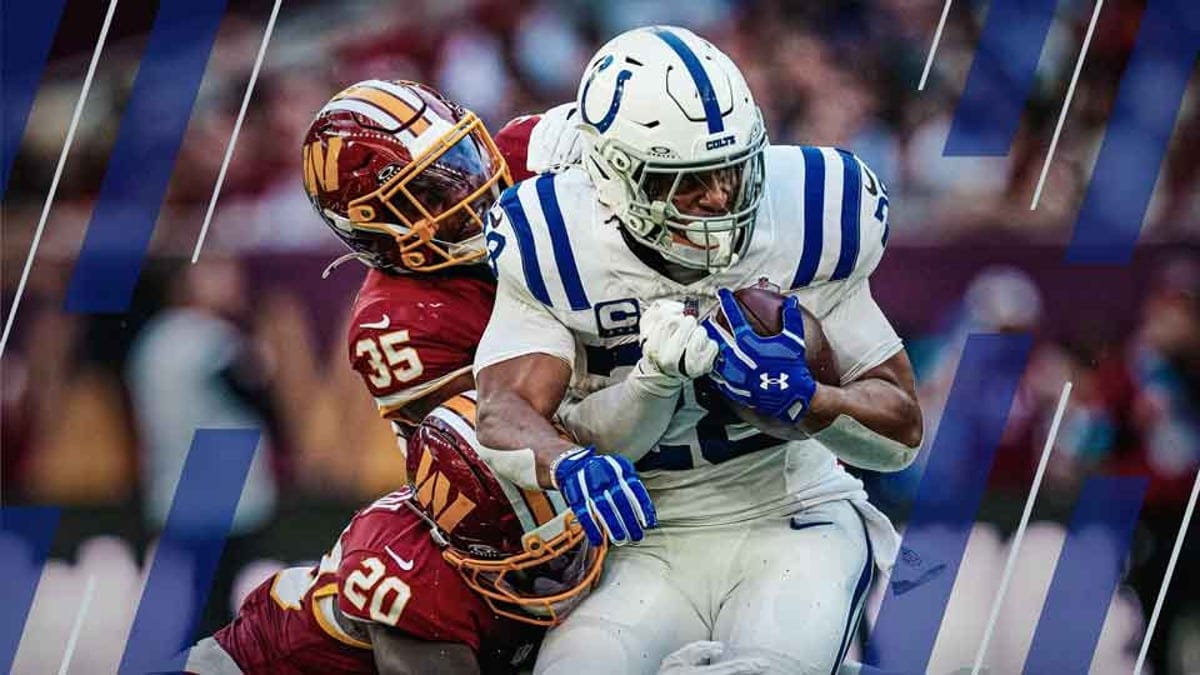
- Austin Ekeler returns for Washington: With Rachaad White out injured, Ekeler became Washington’s leading rusher despite being on the team for less than a week.
- PFF+ is now just $9.99 a month, down from $24.99: That’s 60% off the old monthly price for the same subscription, including premium articles and analysis, fantasy football tools, NFL and College grades, betting tools, access to the mock draft simulator and Guru AI football chatbot insights. Click here to subscribe.
PFF’s fantasy football recap focuses on player usage and stats, breaking down the key information you need to achieve fantasy success in 2026.
For fantasy players looking for additional data and tools, PFF+ provides access to fantasy and betting resources, the Mock Draft Simulator and more for $9.99 per month or $99.99 per year. Those who want to dive even deeper can sign up for PFF Pro, which comes with an upgraded Premium Stats Pro experience, revamped player and team pages, enhanced data and visualizations and programmatic data access for modeling.
Indianapolis Colts @ Washington Commanders
Commanders adjust without Rachaad White: Washington’s receiving back was inactive with a shoulder injury.
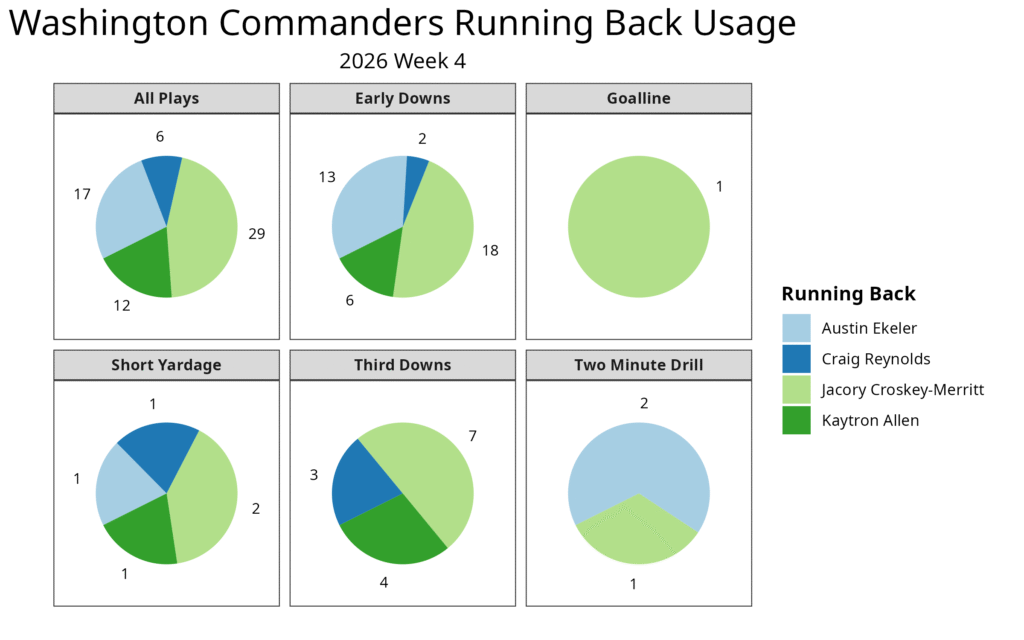
The Commanders have used a traditional two-man rotation to start the season, with Jacory Croskey-Merritt handling most of the early-down work and White playing primarily on passing downs. The two have split short-yardage opportunities, although White has dominated the goal-line work. Kaytron Allen has been the only other running back to get playing time this season, but he has logged just 13 snaps.
White didn’t practice all week because of a shoulder injury, prompting Washington to bring back Austin Ekeler, who served as the team’s receiving back last season before suffering a torn Achilles. The Commanders also elevated Craig Reynolds from the practice squad, leaving all four healthy running backs active for this game.
Croskey-Merritt’s initial usage was extremely promising. He played nine of the first 10 snaps and handled all three third-down snaps across Washington’s first two drives. That suggested a feature role, which would make him a must-start option as long as White remained sidelined.
That didn’t last. Croskey-Merritt was ineffective as a runner, and the rotation became much more chaotic for the remainder of the first half as Washington moved away from its typical early-down/passing-down split. Ekeler operated as the primary back at times, while Reynolds also mixed in.
Washington settled into a clearer rotation in the second half, with Croskey-Merritt and Ekeler splitting early-down snaps. Croskey-Merritt, Allen and Reynolds all saw opportunities on third downs.
This performance makes Croskey-Merritt much harder to trust going forward. Ekeler becomes a waiver-wire target, as he could emerge as Washington’s top running back option. The second-half rotation also suggests the Commanders could use a three-man backfield even after White returns, with Croskey-Merritt and Ekeler handling early-down work and White taking most of the passing-down snaps.
It’s also bad news for Allen. He appeared to be one injury away from a significant role, but both Ekeler and Reynolds played ahead of him with White sidelined. That makes it difficult to envision Allen holding meaningful fantasy value anytime soon.
Commanders turn to a four-man wide receiver rotation: Washington needed to adjust without its top wide receiver, Terry McLaurin.
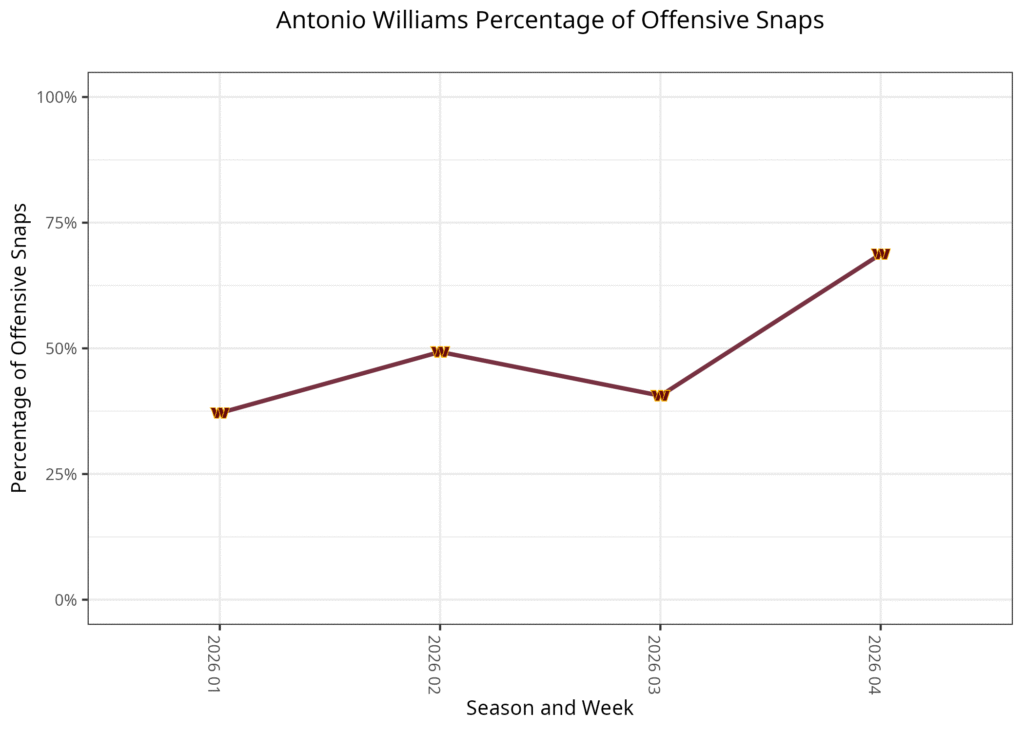
McLaurin has been Washington’s clear leader at wide receiver in terms of playing time this season, although he has played only 77.6% of the Commanders’ offensive snaps. Stefon Diggs, Dyami Brown and Antonio Williams have each played between 40% and 60% of the snaps, while Treylon Burks and Jaylin Lane have also mixed in. Burks’ role has increased as the season has progressed. McLaurin was officially questionable for this game with a hamstring injury but ultimately did not play.
Without McLaurin, Washington leaned on a four-man rotation of Diggs, Brown, Williams and Burks. Brown and Burks were the most likely receivers to play in 12 personnel, while Diggs and Williams were consistently joined by one of the two in 11 personnel. Based on where he lined up, Brown served as the most direct replacement for McLaurin.
None of the wide receivers had particularly strong games with Washington down to its third-string quarterback, although Diggs emerged as Athan Kaliakmanis’ favorite target. Kaliakmanis connected on a few nice deep throws later in the game, leading to big catches by Brown and Burks.
Ultimately, this level of rotation — even with Washington’s top wide receiver sidelined — makes it difficult for any member of the group to develop consistent fantasy value.
Chig Okonkwo returns to Washington: The Commanders’ newest tight end returned to the role he held early in Week 1, at least for the first half.
Washington signed Chig Okonkwo in free agency this offseason. He was the Commanders’ clear lead tight end in Week 1, playing 39 of 48 snaps over the first 10 drives before suffering a hamstring injury that sidelined him for the next two weeks. He ran a route on 85% of Washington’s pass plays over those drives, an elite rate for a tight end. Last season, Trey McBride and Sam LaPorta were the only tight ends to exceed an 85% route participation rate. Okonkwo was limited in practice all week but entered the game without an injury designation.
Okonkwo returned to a significant role, playing in most 11 personnel situations as well as 13 personnel. Washington used 13 personnel frequently early in the game, typically with Okonkwo functioning as the second receiving option. Most of his time off the field came in 12 personnel on running plays.
He ran a route on 14 of 17 first-half pass plays, another excellent participation rate for a tight end. His playing time declined in the second half, with John Bates seeing more work, particularly as a pass blocker. Washington may simply have wanted additional help in pass protection, although it’s also possible Okonkwo wasn’t quite 100% in his first game back.
Okonkwo didn’t produce much statistically, but the circumstances weren’t particularly favorable. Washington was down to its third-string quarterback and didn’t fall behind until later in the game, which allowed the offense to stay relatively committed to the run.
The route participation is far more encouraging for his fantasy outlook. Okonkwo is worth targeting on the waiver wire, especially if Jayden Daniels or Marcus Mariota eventually return at quarterback. If the route participation he showed early in Week 1 and again in the first half of this game carries over to full games, he could become a useful fantasy option.
Colts adjust down multiple wide receivers: Two of Indianapolis’ top three receivers from the start of the season were unavailable.
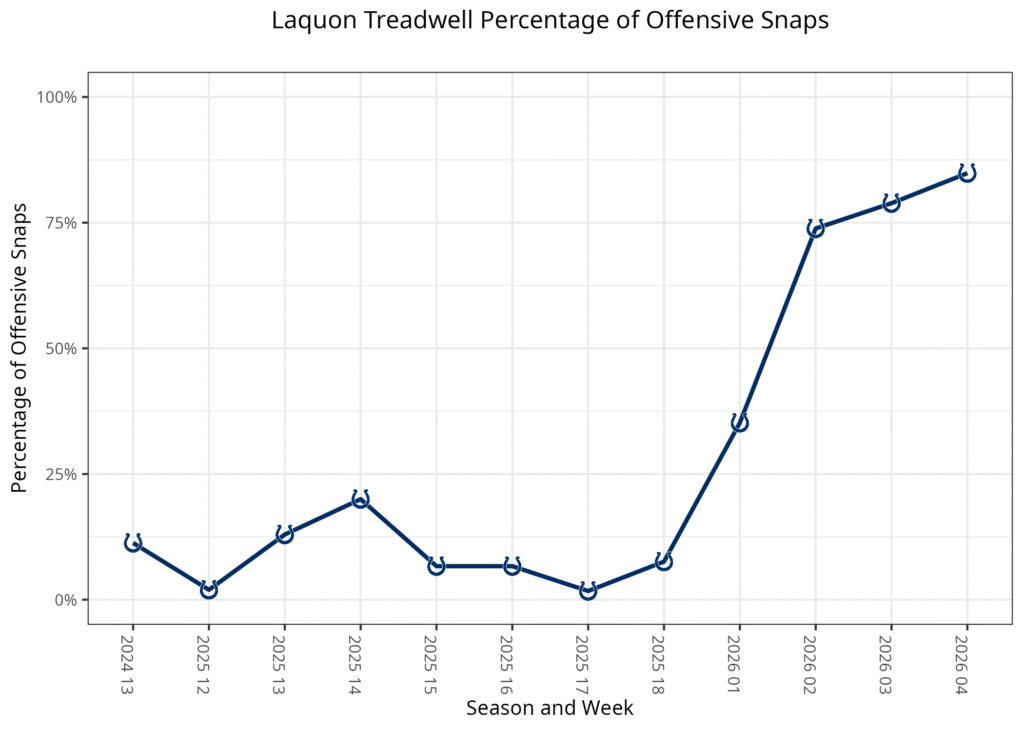
The Colts opened the season with Alec Pierce as their X receiver and Josh Downs playing Z in 12 personnel before moving into the slot in 11 personnel. Keenan Allen has primarily played Z in 11 personnel. Pierce is currently on injured reserve, allowing Laquon Treadwell to take over at X. Allen also got an expanded role last week, which initially looked promising for his fantasy value, but he suffered a groin injury mid-week and was inactive for this game.
Indianapolis had several options to replace Allen. The Colts recently signed Darius Slayton, while Ashton Dulin returned after missing two games with an ankle injury. Younger receivers Deion Burks and Anthony Gould were also active, along with practice squad call-up Nick Westbrook-Ikhine. Slayton, however, was a healthy inactive for the second straight week.
Dulin stepped into Allen’s role as the Colts’ primary Z receiver in 11 personnel. Burks backed up both Downs and Dulin, while Westbrook-Ikhine was primarily used as the lone wide receiver in short-yardage packages featuring either three tight ends or two tight ends and a sixth offensive lineman.
Dulin’s usage is particularly noteworthy because Allen could face a suspension at some point this season following his drunk-driving arrest earlier in the year. That could give Dulin some fantasy value in deeper leagues. Still, it’s difficult to get excited about any Indianapolis receiver outside of Downs until Slayton gets into the lineup and we see how the Colts intend to use him.
Miscellaneous Notes
- Jayden Daniels missed his second straight game with a left elbow injury, leaving Marcus Mariota to start. Mariota then suffered a knee injury midway through the first quarter, forcing Washington to turn to seventh-round rookie Athan Kaliakmanis for the remainder of the game. Mariota was officially ruled out at halftime.
- Commanders wide receiver Luke McCaffrey was a healthy inactive. He has appeared in only one game this season, playing exclusively on special teams in Week 3.
- Backup wide receiver Jaylin Lane suffered an ankle injury on a return and was carted off before quickly being ruled out. If the injury is as serious as it appeared, Lane could miss significant time, and McCaffrey could move up the depth chart in his absence.
- The Colts continued to dress only two running backs, with DJ Giddens again a healthy inactive.
- Backup running back Seth McGowan received more playing time than usual. He has typically mixed in early in the second quarter, but this week, he handled the entire drive to open the period.
Tennessee Titans @ Baltimore Ravens
Coming soon!
New England Patriots @ Buffalo Bills
Coming soon!
New York Jets @ Chicago Bears
New York adjusts without Breece Hall: The Jets’ usual lead running back was inactive with a quadriceps injury.
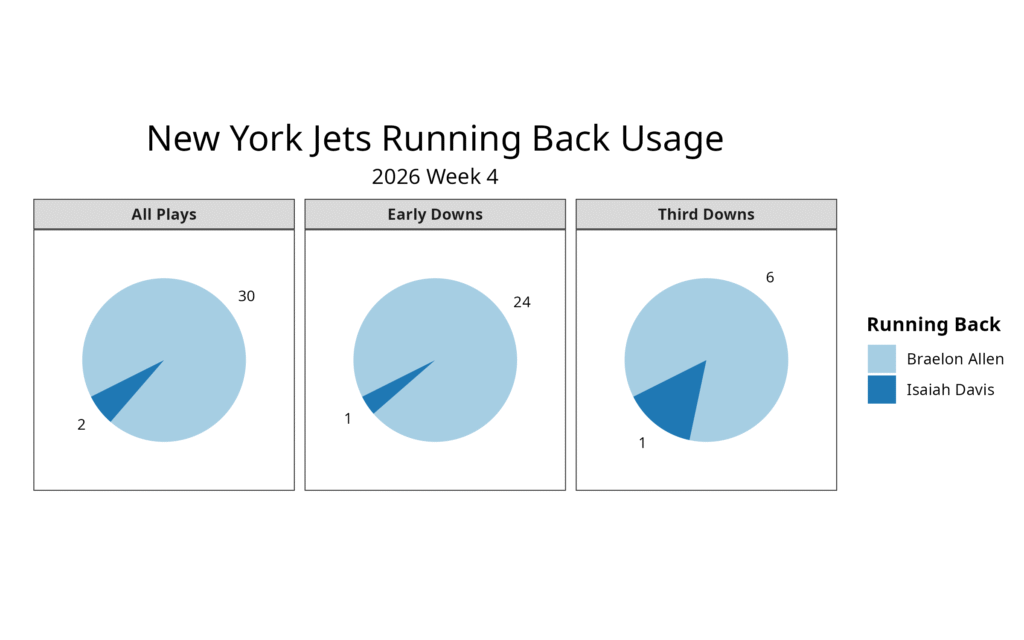
The Jets have only used two running backs this season, with Hall as their lead back and Braelon Allen as the backup and receiving back. Isaiah Davis was the backup last season but has only played on special teams over the first three weeks. Hall suffered a quad injury last week, leading him to miss this week, and he’s expected to be out for another two games.
Allen ended up playing 30 of a possible 32 snaps for the Jets. Chicago dominated time of possession, significantly impacting playing time for both teams. New York only had one drive lasting more than five plays, which was early in the third quarter. That possession was seven plays, and that was the drive where Davis took two snaps for Allen.
Allen took all 14 carries and caught two passes. While this wasn’t his best game, the usage was extremely promising and gives Allen a higher ceiling for the next few weeks than Hall had over the first three weeks. The Jets’ matchup against the Cleveland Browns isn’t great, but Allen can be in fantasy starting lineups in Week 6 against the New England Patriots, and potentially Week 7 against the Miami Dolphins if Hall isn’t back yet.
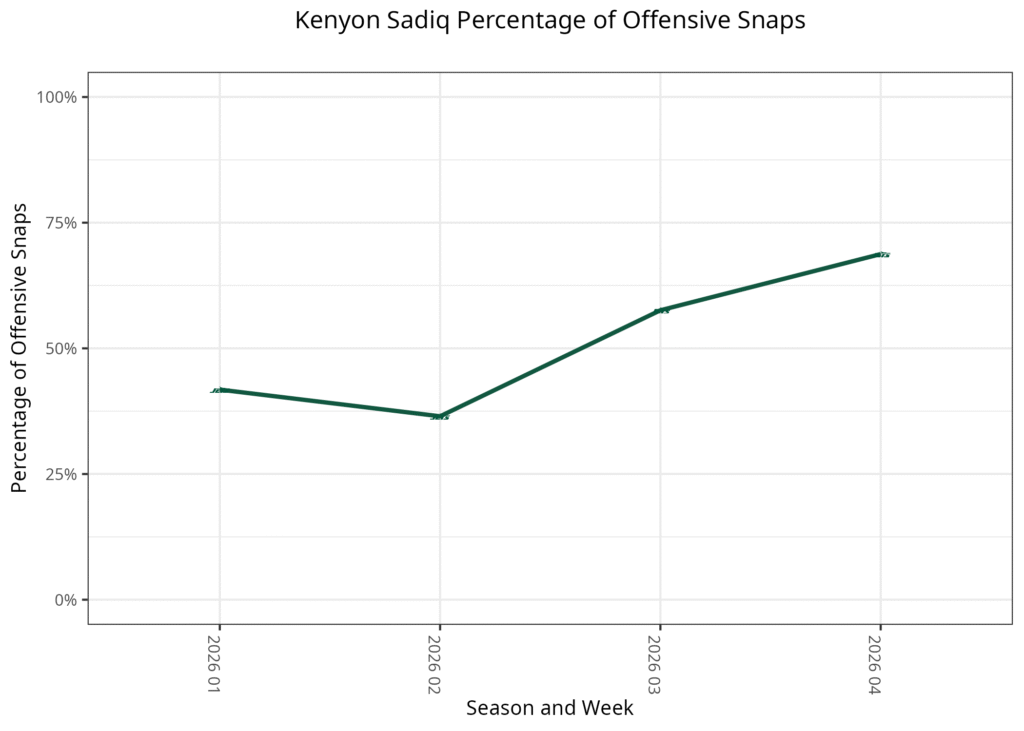
Kenyon Sadiq’s playing time takes a step forward: The first-round rookie was held without a catch, but his usage was more promising than last week.
The Jets started the season with a four-man rotation at tight end between Sadiq, Mason Taylor, Jeremy Ruckert and Jelani Woods. Taylor was inactive last week with a thumb injury, allowing Sadiq to see more playing time. He took advantage of the opportunity, catching seven passes for 105 yards and a touchdown.
Taylor also missed this week, but the Jets’ other tight ends weren’t 100%. Sadiq (back) and Ruckert (knee) were limited in practice all week. Despite this, Sadiq’s snap rate was up. On early downs, he played 63.6% of 11 personnel snaps, similar to last week. He only played half of the third-down snaps in 11 personnel. The big difference was in 12 personnel, where he played 78.6% of snaps. He only played 47.6% of those snaps last week.
That left Sadiq with a 68.8% snap rate, up over 10% compared to last week. His route participation rate was also up nearly 10% to 68.7%. His target rate was still a promising 25%, although not as high as Week 3.
The problem is none of Sadiq’s targets were catchable this week, and New York only ran 32 plays. Some fantasy managers may overreact to the goose egg and drop Sadiq, but he is still a rookie in the first month of his career. The improved utilization should be viewed as a positive sign for how he might perform over the second half of the season. In the leagues where he isn’t dropped, he should be a considered buy-low candidate.
D’Andre Swift benched for Chicago: A fumble led Swift to not play in any of the final three drives for Chicago.
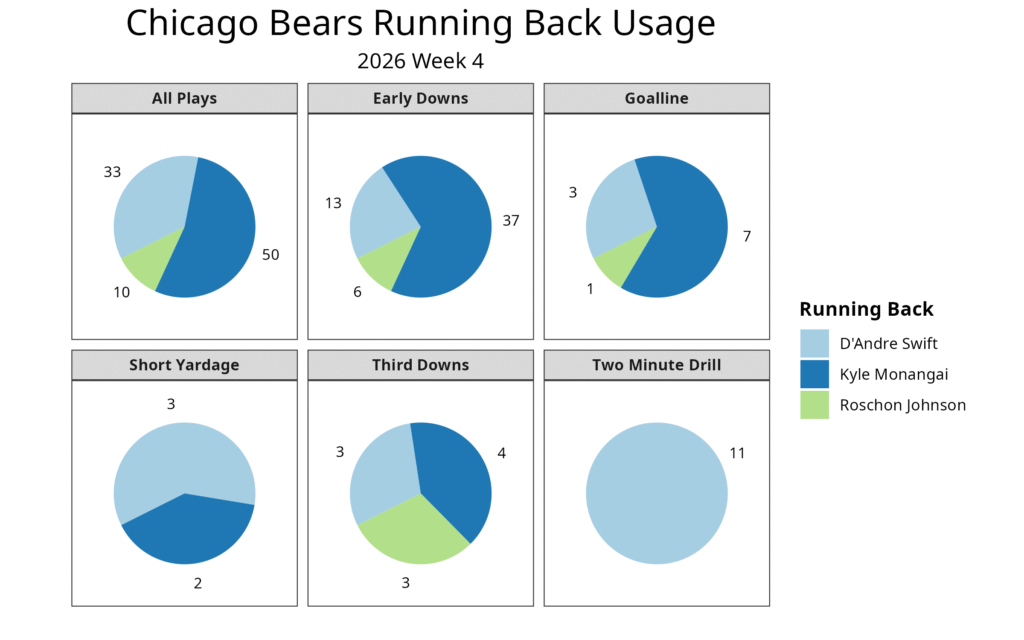
Chicago has started this season with a similar two-man rotation as last season, with Swift playing 64.7% of snaps and Kyle Monangai 35.7%, and Swift handling the majority of snaps in all situations. Over the first six drives of this game, the rates were slightly closer together, at 61.1% to 38.9%. That was largely because Chicago ran 54 plays over those six drives, which is more than usual, which naturally lends itself to more rotation.
The Bears’ sixth drive was the first one in the third quarter, and Swift lost a fumble. That quickly led the Jets to score a field goal, making it a one-score game. Chicago had three more drives over the rest of the game, which lasted a ridiculous 39 plays. During that time, Monangai played 29 snaps to 10 by Roschon Johnson. Monangai ran 18 times during the stretch, compared to four runs by Johnson. If the Bears continued their usual rotation over those drives, Swift would have likely seen at least 10 more carries.
Swift has only fumbled three times in a season at most, but this was his second one of the 2026 campaign. As long as Swift doesn’t fumble again anytime soon, I wouldn’t expect the running back rotation to change. However, it might only take another Swift fumble for Monangai to become the lead back in Chicago, and the weekly must-start option.
Miscellaneous Notes
- Bears quarterback Caleb Williams missed his second game with a hamstring injury. Last week, Case Keenum started in his place after Tyson Bagent missed most of practice leading up to the game with a concussion. This week, Bagent was the starter.
- Chicago running back D’Andre Swift didn’t practice on Thursday with a knee injury, but he was able to practice in full on Friday and wasn’t given a game status.
- Luther Burden III’s snap rate fell to a season-low 55.9% this week, even though he played over half of the 12 personnel snaps for the first time since Week 1. The Bears ran more 13 personnel than usual, at 20 total plays, and 12 personnel for a season-high 43 plays. His route participation rate was nearly identical to his season average.
- Colston Loveland more consistently lined up in 11 personnel over Cole Kmet compared to the first three weeks, leading to Loveland playing 92.5% of snaps. This was the highest rate for a game in Loveland’s career, which is remarkable considering Chicago ran 93 offensive plays.
- New York wide receiver Adonai Mitchell missed his second straight game with a finger injury, while tight end Mason Taylor sat out his second consecutive game with a thumb injury.
- The Jets activated wide receiver Sterling Shepard from the practice squad for this game on Saturday. Similar to last week, he was the third wide receiver, with Isaiah Williams as the second receiver. Shepard rotated out of 11 personnel less frequently than last week, leaving Malik McClain with reduced playing time.
- New York running back and returner Kene Nwangwu returned after missing three straight games with a back injury.
- The Jets signed Jason Sanders to the active roster and released Blake Grupe after having Sanders as a practice squad call-up each of the last three weeks.
Jacksonville Jaguars @ Cincinnati Bengals
Coming soon!
Dallas Cowboys @ Houston Texans
Coming soon!
Arizona Cardinals @ New York Giants
Coming soon!
Los Angeles Rams @ Philadelphia Eagles
Coming soon!
Green Bay Packers @ Tampa Bay Buccaneers
Coming soon!
Miami Dolphins @ Minnesota Vikings
Coming soon!
Kansas City Chiefs @ Las Vegas Raiders
Coming soon!
Los Angeles Chargers @ Seattle Seahawks
Coming soon!
Denver Broncos @ San Francisco 49ers
Coming soon!
Detroit Lions @ Carolina Panthers
Coming soon!
Table Notes
• Snaps include plays called back due to penalties, such as offensive holding or defensive pass interference. The other three stats exclude these plays.
• Targets may differ from official NFL sources. The most likely discrepancy will be from a clear thrown-away pass where the NFL may credit the nearest receiver, but this data will not.
• Carries are only on designed plays. Quarterback scrambles won’t count toward the total number of carries in the game.