This story is part of Peak, The Athletic‘s desk covering the mental side of sports. Sign up for the Peak newsletter here.
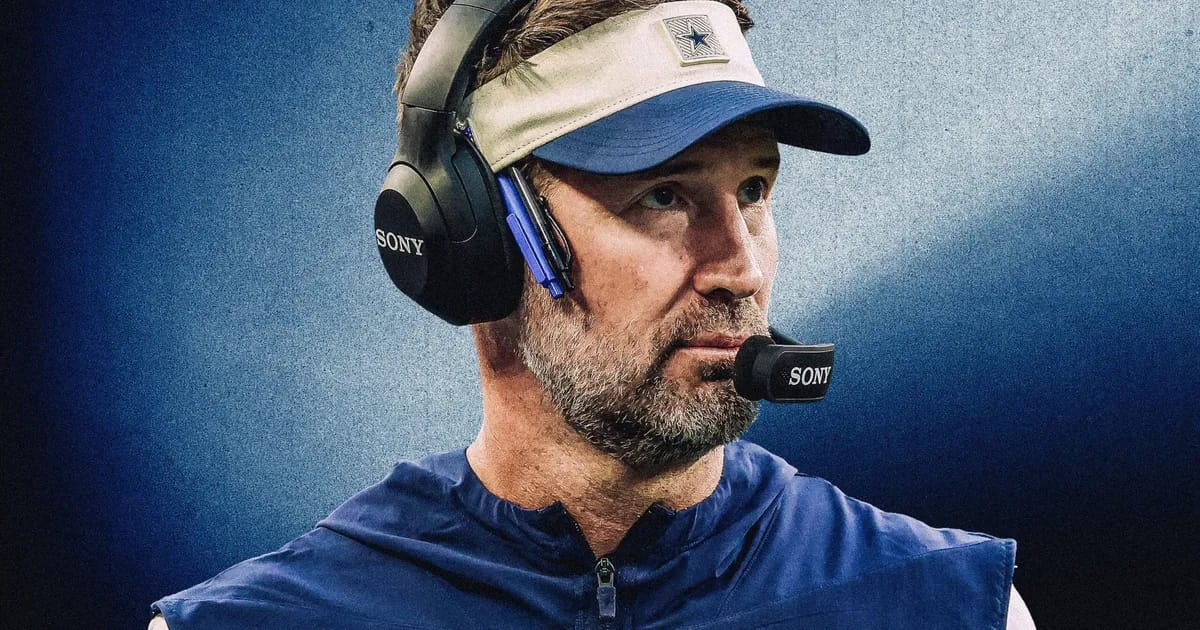
As Dallas Cowboys coach Brian Schottenheimer sees it, it wasn’t a strategic issue that derailed his team’s chances in a last-second loss to the Baltimore Ravens.
It’s word choice.
The situation occurred on Sunday in Rio de Janeiro. Trailing 31-28, the Cowboys faced third-and-goal from the 5-yard line with 14 seconds left, leaving time for a game-winning touchdown. Dak Prescott, the Cowboys’ quarterback, had a quick open on receiver George Pickens, but he rushed the decision and threw the ball quickly.
The Cowboys settled for a tying field goal, and the Ravens kicked a game-winning field goal with one second left.
That left Schottenheimer explaining the careful management of the game, which he said was partly the fault of his messaging with Prescott.
“I have a lot of confidence in Dak Prescott,” Schottenheimer told reporters. “So it was the word that I chose, which I’m not going to give away. The words that we say have meaning. And when I said the word, it put him into a mindset that he doesn’t play. He doesn’t play that way.”
In Dallas, the answer contributed to a week of investigation. But among mental performance coaches and sports psychologists, it has also invited an intriguing discussion about the power of language, attentional cues and coaches’ ability to unwittingly influence a player’s decisions or mindset.
Words — and the way they are delivered — can change our brains and affect our cognitive decision-making in surprisingly powerful ways, over time and in the most crucial moments of a game. This is the essence of teaching. But science reveals how easy it is to go wrong.
“If I use the word no, it causes a different kind of reaction in the brain than if I use the word yes,” says Andrew B. Newberg, a neuroscientist and professor at Thomas Jefferson University. “And, obviously, you can extrapolate that into all kinds of positive or negative words.
“Part of what happens, ultimately, is that if you interact with someone negatively, then that releases a whole range of effects in their brain and in their body. It puts them under stress.”
For athletes conditioned to cue words or phrases, the effect may be greater. One reason is because the wrong word or phrase can impair an athlete’s attention or focus, pulling them out of their subconscious performance (or flow) state. Another is due to the classic neuroscientific idea that “neurons that fire are connected together.”
When an athlete has certain experiences associated with certain words or phrases, Newberg said, it can affect the wiring of an athlete’s brain, influencing how he or she responds when hearing a particular phrase.
“By using certain words, you evoke neural connections and ultimately you can evoke something positive or something negative,” Newberg said.
Put another way: If a coach repeatedly uses the same words – as we got it – to encourage calm in stressful situations, those words will have more power when said again.
Sean McVay has two leadership qualities that make him unique as an NFL player
Elise Devlin
Professional coaches probably understand this relationship better than most. A longtime NFL quarterback coach believes his words have the power to “help make or kill a QB.” In contrast, former NFL quarterback Matt Hasselbeck said later in his career that he often knew what a coach was going to say before he even said it, so the impact of the words was lessened.
In any case, it is often the immeasurable nature that makes it difficult to know the exact impact of a coach’s word choice.
Justin Anderson, a sports psychologist at Premier Sport Psychology in Minnesota, has worked with NFL quarterbacks, coaches and business leaders. He says he is often struck by the stark contrast between professional sports and the corporate world.
“I went to Target Corp and they were training their midlevel managers in multimillion-dollar training sessions to get them to engage and develop their people in the most effective and efficient way possible,” Anderson said. “And you go to an NFL team — and that’s a billion-dollar industry — and very few do anything to train their coaches on the impact of communication and how to coach.”
To illustrate, Anderson often uses a focus study on soccer players. In the study, a group of players were asked to dribble a ball through a set of cones, up and down the field, while the researchers used a series of coaching cues for the players.
A cue told the players to go as fast as they could. Another tells them to focus on where the ball is at their feet. A third said to stay as close to the cones as possible.
The third cue produced the fastest time, which the researchers said suggested a simple idea: When it comes to verbal instructions, it’s possible to be too broad and too technically specific.
Instead, athletes often perform best when coaches can provide words and direction that can provide a measure of focus and freedom at the same time.
“Where we focus our attention has a tremendous impact on our emotions and behavior,” Anderson says.
There’s a reason, Anderson said for example, that a caddy never tells a golfer: “Don’t hit it in the water.”
In this case, Schottenheimer never revealed the magic word in his conversation with Prescott. Neither did the quarterback.
But one thing is clear: Schottenheimer thought it caused his quarterback to play more cautiously.
I wish he had said something else.