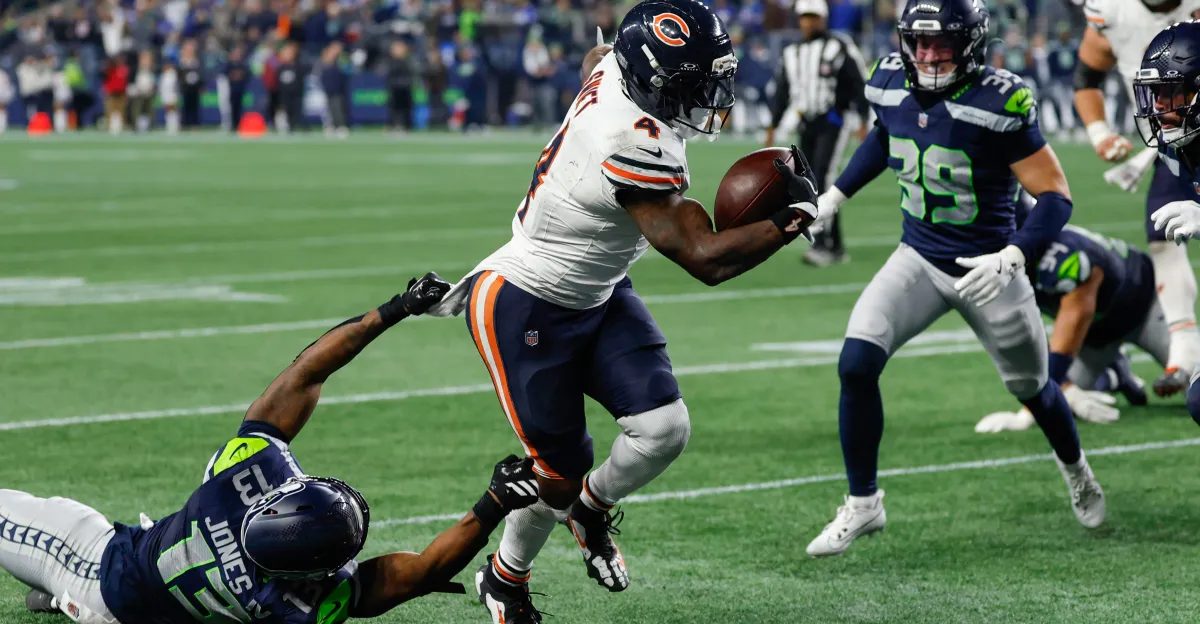
The Seattle Seahawks are 4-4, just lost by 17 points to the Chicago Bears on Monday night, but still have a +26 point differential. Turnovers have obviously been a big factor in three of their four losses, but a season-long issue for Seattle’s offense and defense doesn’t seem to be going away.
Neither unit is doing work in the red zone.
Seattle’s offense is one of the worst in the red zone
Seattle’s offense ranks a dismal 29th in red zone touchdown percentage, scoring just 13 TDs on 28 drives. If you look at points per trip into the red zone, which obviously includes field goals, Seattle still ranks 29th. For whatever reason, even though red zone performance is a highly variable statistic, the Seahawks have never fielded a top-16 offense in points per red zone possession in the post-Russell Wilson era. Currently, this is the Seahawks’ worst offense in the red zone since 2016, when they had a mostly injured Wilson at quarterback, a severely injured running back unit, and an offensive line that was a total horror show.
While the red zone covers the 20-yard line and inside, there is one observation I’ve made all season with Brian Fleury’s playcalling. When the Seahawks face a goal-to-go situation, Fleury’s default move is to run the ball with mixed (at best) results. I’m not kidding: 12 runs to 1 pass. The pass was a touchdown to Cooper Kupp in the hurry-up offense against the Washington Commanders, by the way.
No other team (even using Stathead’s play-by-play data) is more first-and-goal heavy than Seattle. Only the New York Giants and Cleveland Browns have thrown it once on first-and-goal. Last season, the Seahawks had a pass-run ratio of 14:19 on first-and-goal, and while the red zone offense was also lackluster under Klint Kubiak, they weren’t very predictable.
The first-and-goal run isn’t the main reason Seattle is a poor red zone offense, but it’s certainly a factor. We saw very little play-action in the red zone on any downs, and the Seahawks roster in general lacked a true “go up and get” receiving target. That last bit is mostly opinion, but you can count the number of high-point catches made by Seahawks receivers on one hand this year—including Jaxon Smith-Njigba. It’s not a strength of this roster and it should be something Seattle takes into consideration when it’s finally evaluating how to improve the offense next season.
Seattle’s red zone defense is the worst in the NFL
This part is very beautiful. The Seahawks defense as a whole is still playing very well, but they are losing in key situational areas at an alarming rate. They ranked 32nd in red zone efficiency, allowing touchdowns on 15 of 18 possessions. Last year they were the fifth best at preventing red zone touchdowns, and now they’re just bleeding them on every drive.
By FTN’s DVOA, they are last in red zone pass, red zone rush, and goal-to-go situations. It probably wouldn’t matter much if the Seahawks’ offense wasn’t performing so poorly wherever they were on the field, but Seattle is costing themselves a win on these weekly differentials.
And while this is a post about the red zone, the Seahawks defense is the worst 4th down unit in the NFL, giving up 10 of 11 conversions. This was not the only place where they fell.
Seattle became Super Bowl champions last season by “chasing the rim” and winning games within games. It’s the little things that add up to successes. They’re getting their asses kicked at the margins, and if red zone performances don’t improve soon, they’ll find themselves missing the playoffs for the fourth time in six seasons.