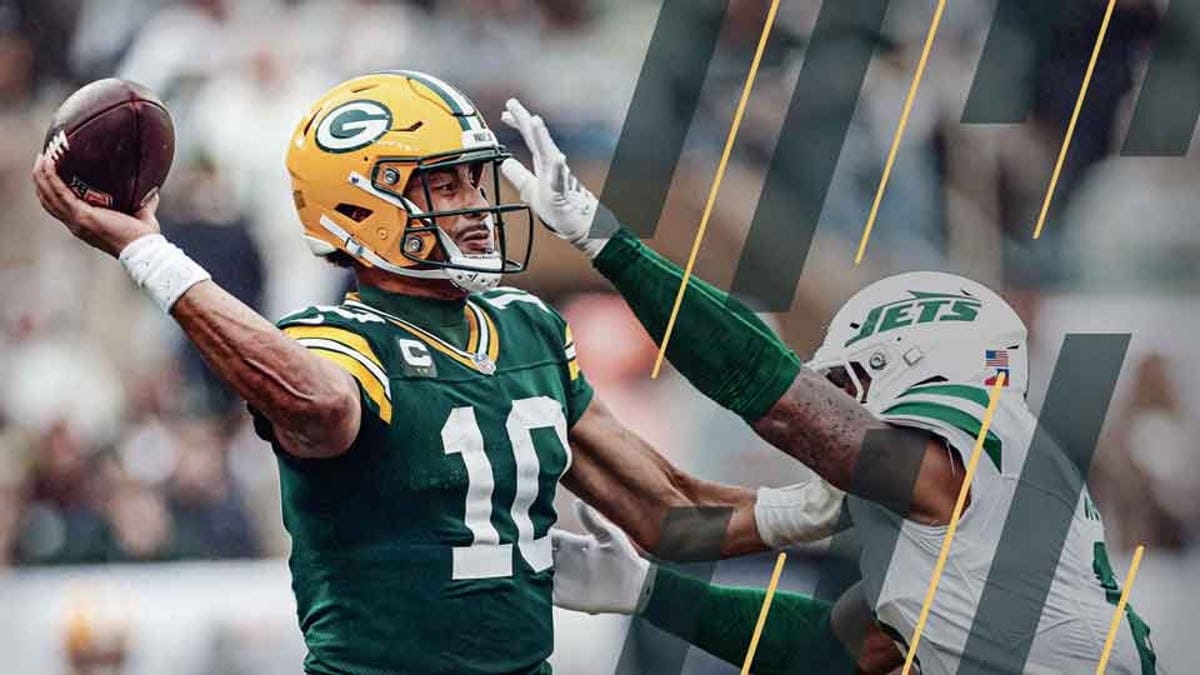
- Worst pass protection in the league: Green Bay earned a 41.7 PFF pass-blocking grade and allowed an NFL-high 51 pressures through three games.
- The pressure hurts Jordan Love: Love faced pressure on a career-high 44.4% of his dropbacks, with his PFF passing grade dropping from 76.5 when clean to 25.1 under pressure.
- Introducing the NEW PFF Pro subscription: PFF Pro includes everything in PFF+, plus an upgraded Premium Stats Pro experience, increased base access to Guru AI, revised player and team pages, improved data and visualization, an improved interface and programmatic data access for modeling. Click here to subscribe.
PFF Plus
NEW – PRICE LOW!
$9.99
per month, billed monthly
The one you unlock
MOST FLEXIBLE
- PFF+ content and tools
- Articles, Fantasy tools, NFL and College tools, Betting
- Access to the mock draft simulator
- Guru AI football chatbot insights with limited tokens
PFF Plus
NEW – PRICE LOW!
$99.99$8.33 /month
per year, billed annually
The one you unlock
MOST IMPORTANT
- PFF+ content and tools
- Articles, Fantasy tools, NFL and College tools, Betting
- Access to the mock draft simulator
- Guru AI football chatbot insights with limited tokens
- Premium Stats
- Micro transactions are available for additional tokens
PFF Pro
$199.99$16.67 /month
per year, billed annually
The one you unlock
ELITE
- PFF+ content and tools
- Articles, Fantasy tools, NFL and College tools, Betting
- Access to the mock draft simulator
- Guru AI with higher base token level
- Upgraded Premium Stats Pro
- Micro transactions are available for additional tokens
- Revised player and team pages
- Improved data and visualization
- Improved Interface
- Programmatic data access for modeling (API/scrape)
The Green Bay Packers’ pass protection hasn’t just struggled through three games of the 2026 season. By almost any measure, this is one of the NFL’s biggest problems.
After three games, the Green Bay offensive line has earned a 41.7 PFF pass-blocking grade and a 78.9 pass-blocking efficiency rating, both last among the NFL’s 32 offensive lines. The unit has also given up a league-high 51 pressures, 14 more than the next closest team, while its 20 quarterback hits allowed are 12 more than any other team.
And while Green Bay has played one more game than 30 other teams to start 2026, that caveat doesn’t do much to soften the bigger picture. When measured against more than two decades of offensive line play at the same three-game checkpoint, the Packers’ start still stands out for all the wrong reasons.
If we look at every offensive line through the first three weeks of every season from 2006 to 2026 — 672 team-season samples in all — the line’s 31.9% pass-block win rate is the seventh lowest among those units. Their 16.5% knockdown rate is tied for the highest, and they’ve allowed the most quarterback hits of any offensive line in the dataset, with 20.
Most knockdowns allowed by an offensive line in three weeks (2006-2026)
| Team | Season | Total knockdowns |
|---|---|---|
| Dolphins in Miami | 2011 | 27 |
| Green Bay Packers | 2026 | 25 |
| Cleveland Browns | 2013 | 24 |
| Seattle Seahawks | 2011 | 24 |
| Arizona Cardinals | 2009 | 23 |
| Indianapolis Colts | 2021 | 23 |
| Minnesota Vikings | 2023 | 23 |
The problems also spread to the offensive line.
Jordan Morgan’s 63.9 pass-blocking grade ranks 43rd among 66 qualifying offensive tackles, and his 11 pressures allowed are tied for the most at the position. Anthony Belton ranks 63rd among 66 tackles with a 42.2 pass-blocking grade, while his 76.7% pass-block win rate ranks 65th.
Things didn’t get any better in the interior. Jacob Monk’s 41.9 pass-blocking grade ranks 57th among 70 guards, and his 11 pressures allowed are the worst mark at the position. Jager Burton’s 17.2 pass-blocking grade is 69th out of 70 guards, while his 76.5% pass-block win rate holds up.
Sean Rhyan earned a 53.0 pass-blocking grade, which was 27th out of 32 centers. He surrendered six pressures, tied for second most at the position.
Packers offensive linemen starting in 2026
| Packers offensive lineman | Position | Pass-blocking grade | Position rank |
|---|---|---|---|
| Jordan Morgan | T | 63.9 | 43rd of 66 |
| Zach Bako-Bewele | T | 57.6 | 52nd of 66 |
| Donovan Jennings | Mr | 53.7 | 46th of 70 |
| Sean Ryan | C | 53.0 | 27th of 32 |
| Anthony Belton | T | 42.2 | 63rd of 66 |
| Jacob Monk | Mr | 41.9 | 57th of 70 |
| Jaeger Burton | Mr | 17.2 | 69th of 70 |
The result is a pressure environment unlike anything Jordan Love has ever experienced.
Love has been pressured on 44.4% of his dropbacks this season, the highest rate of his career and the fourth highest rate among qualified quarterbacks. His previous career high was 38.6% in 2025.
Jordan Love: Career pressure rate
| Season | Pressure rate |
|---|---|
| 2026 | 44.4% |
| 2025 | 38.6% |
| 2024 | 35.0% |
| 2023 | 30.8% |
| 2022 | 19.0% |
| 2021 | 35.7% |
And the difference in Love’s production under those conditions is huge.
With his 74 clean dropbacks this season, Love produced a 76.5 PFF passing grade, completed 63.5% of his passes and averaged 7.3 yards per attempt. He threw six touchdowns without an interception, produced a 112.6 passer rating and averaged a 0.30 EPA per play.
Under pressure, his PFF passing grade dropped to 25.1. He has completed 36.0% of his passes, thrown zero touchdowns against two interceptions and produced a 40.4 passer rating. His EPA per play fell to -0.43, and six of his forced plays were recorded as turnover-worthy.
| Jordan Love (2026) | No pressure | Under pressure |
|---|---|---|
| PFF passing grade | 76.5 | 25.1 |
| Adj. comp rate | 75.3% | 45.2% |
| Yards per attempt | 7.3 | 6.0 |
| Big-time throws | 1 | 1 |
| Turnover-worthy plays | 1 | 6 |
| NFL passer rating | 112.6 | 40.4 |
| EPA per play | 0.30 | -0.43 |
Three weeks is still a small sample, but the early returns leave little ambiguity about the extent of Green Bay’s pass-protection problems. The Packers rank at or near the bottom of the NFL in nearly every major measure of protection, several individual linemen sit near the bottom of their respective positions, and Love faces pressure more often than at any previous point in his career.
For an offense that asks its quarterback to operate behind that kind of protection, the consequences are showing everywhere.