Getty
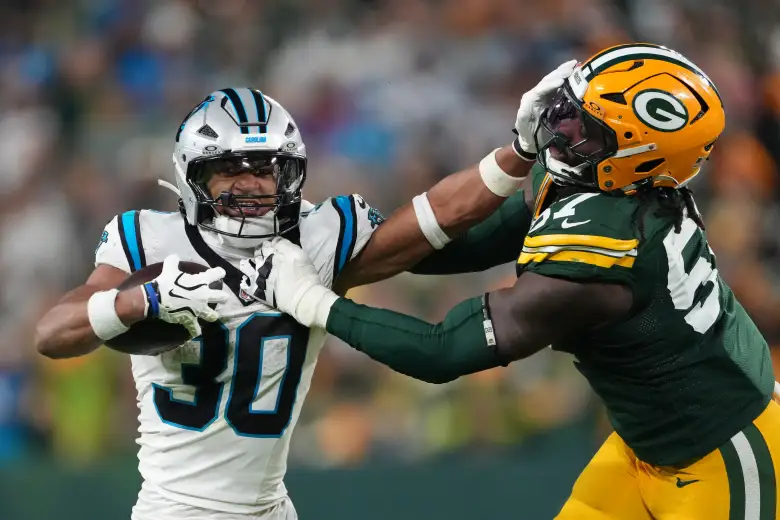
GREEN BAY, WISCONSIN – OCTOBER 29: Chuba Hubbard #30 of the Carolina Panthers tackles Brenton Cox Jr. #57 of the Green Bay Packers during the third quarter at Lambeau Field on October 29, 2026 in Green Bay, Wisconsin. (Photo by Patrick McDermott/Getty Images)
For most of football history, the Carolina Panthers kicked the extra point at this spot.
On Thursday Night Football at Lambeau Field, the Panthers were down 14 points until Jalen Coker made a great catch-and-run on fourth down to find the end zone.
OK, so the math would go — you’re down 14, you get 6 on touchdown, you sick the extra point to pull within 7. Then you do it again. right?
Well, that’s not what the Panthers did.
They go for the 2-point conversion. Bryce Young caught the snap in shotgun, shifted, and fired a pass that was eventually deflected out of the back of the end zone.
So on the failed 2-point try. The Panthers remained down 27-19, an eight-point deficit when they could have trailed by seven with less than six minutes remaining.
Analytics would say go for it, and believe it or not, it actually makes sense.
Sadly for the Panthers, it didn’t matter. They never scored again to make it relevant.
Why Did The Panthers Go For 2 Down 8?
The Panthers went 2 down 8 because it actually gives you a better chance to win the game.
Teams play to win the game, as the saying goes, not to tie it.
A successful 2-point conversion there means another touchdown — which you’ll need anyway — will add up to an extra point at that time for the lead.
The unsuccessful attempt at least lets the Panthers know they still need 8, so the next time they score, they go for 2 again.
The general thinking is that the 2-point conversion is close to a 50-50 proposition — so the Panthers hope to get the first one, but if not, they believe they can get the second one.
The path of two touchdowns and two extra points only guarantees (if the defense stops) overtime, which in and of itself is probably a 50-50 proposition — and could be worse on the road.
So by going for 2, your chances of winning regulation may increase, and your chances of getting into OT will not decrease that much.
Potentially a point of concern is that the Panthers enter this test just 2-for-10 on 2-point conversions under Dave Canales. But that’s not a huge sample, and they still played what they felt were the right percentages here.
Process vs. Result
The key here is the idea of process versus outcome.
Teams need to approach things with the right process, and the numbers here say it’s the right call.
In a small sample of a 17-game NFL season, however, there aren’t that many times for this to happen — so the results don’t always add up to the process.
If you get a chance to do this 100 times, the numbers say it will work more often than the alternative approach.
But in just one instance, both results can happen, and because of that, it’s even harder for fans to deal with.
All the team can do is make the right plays, though, and the numbers will show that the right call was made. It didn’t work this time.
And since the Panthers didn’t score a second touchdown, it was a moot point.
Billy Hayen Billy Heyen is a Heavy contributor focused on the NFL and MLB. He is a 2019 graduate of Syracuse University who spent his senior year following Jim Boeheim’s basketball team across the country. His reporting work also includes extensive work for The Sporting News, the Sandusky Register and the Democrat & Chronicle of Rochester. Sports writing ventures also led to personal coverage of the Buffalo Sabres, Cleveland Guardians, US men’s national soccer team and various minor league baseball stories. More about Billy Heyen