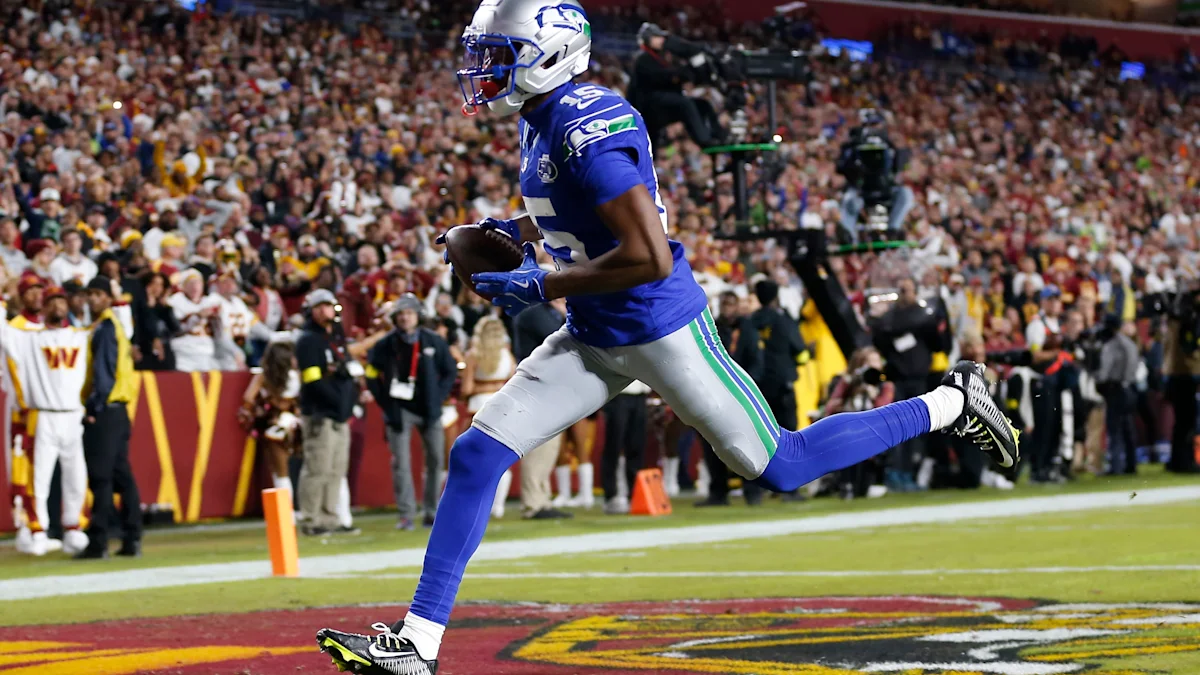
When the Seattle Seahawks won the Super Bowl last season, their impressive run to the Lombardi Trophy was fueled by massive contributions from their rookie class. Gray Zabel started every game at left guard, Nick Emmanwori finished second in Defensive Rookie of the Year voting, Robbie Ouzts got plenty of snaps as a big fullback, while Tory Horton scored five touchdowns before going on season-ending injured reserve. Oh yes, and Rylie Mills’ quasi-redshirt year ended with him sacking Drake Maye in the Super Bowl. It looks like the perfect culmination of an absolutely heated draft for John Schneider.
With Seattle retaining most of its free agents and otherwise sitting at even mid-level free agency, it’s reasonable to assume the Seahawks will look to their 2025 class to shoulder more responsibility and be a bigger factor in 2026.
Advertisement
It didn’t happen. At least not yet.
Gray Zabel continues to be a solid starting guard (although I don’t believe he’s been as good as last season), while Nick Emmanwori is back from ankle surgery and looks to be his usual solid self as a SINO (Safety In Name Only).
That’s where the good times end.
Elijah Arroyo is not much of a factor
Elijah Arroyo has one catch, a personal foul penalty on an interception where he was the target, and that’s about it for his contributions in 2026. Last year, Sam Darnold threw four interceptions targeting Arroyo, compared to just one touchdown. He didn’t have a particularly noteworthy 2025 and was injured in the back-stretch last season, but a terrific preseason didn’t translate into the regular season. If nothing else, it seems very curious why Arroyo played so much in the final preseason game against the Kansas City Chiefs, when most of the would-be starters and main depth didn’t play or maxed out in a series.
Advertisement
There were legitimate questions as to why Arroyo was listed as TE3 on the depth chart and otherwise didn’t get past Eric Saubert, a journeyman blocking TE not known for his receiving abilities. A quick look at this season’s All-22 indicates that Arroyo is generally not trusted in the run game. When he is asked to “block” is really just the opposite of the concept, almost to the point that he is not related to the play even if he is guilty of any responsibilities behind. For whatever reason, Brian Fleury completely reversed the trends against the San Francisco 49ers, with mixed results.
As for his route-running? While there were times I believed Sam Darnold left on the table, the Los Angeles Chargers game alone was a small cosmos of how Arroyo is being used: run really far.
If Arroyo is not trusted as a run blocker and is primarily used in vertical concepts, you have a predictability problem.
Arroyo’s blocking was a known weakness entering the draft, but the idea is that they’ll work on that part of his NFL game and otherwise he’ll be a mismatch hunter in space. We haven’t seen that happen consistently (actually, if ever). Right now, I don’t think Arroyo is a schematic match for an offense that is heavy on 12 and 13 men but needs its tight ends to be reliable blockers.
Advertisement
The mysterious lack of Tory Horton
I can’t explain why Tory Horton was closer to a healthy scratch than a rotational player on offense and special teams on Sunday. Horton playing 11 snaps against the San Francisco 49ers was roughly in line with his normal numbers this season, but only three of those snaps were on pass plays. One of those pass plays was a screen to Emanuel Wilson, so in effect Horton ran two routes all game.
But what surprised me was that Horton lost the kickoff return duties to Velus Jones Jr. Horton played zero special teams snaps, while Velus is the other returner along with Rashid Shaheed. Jones has a history as a kick returner dating back to college. You know what he also has a history with? Scratching
Your guess is as good as mine as long as Horton doesn’t get more playing time, especially since Rashid Shaheed continues to be a minimal factor in the offense.
Advertisement
One thing I will note about Horton is that half of his career productivity in terms of receptions came from just two games against the Washington Commanders. The two games before the Commanders game last year saw him completely shut down. He wasn’t a highly targeted guy before the Rashid Shaheed trade and even less so after. But when the ball is thrown his way, it tends to be a great outcome, as evidenced by six touchdowns on just 17 catches.
Rylie Mills is a rotational player who struggles with the run
I admit I peddled the Rylie Mills hype after watching him in training camp and the preseason. Most of what I liked was as a pass rusher and not as a run defender. He always gave the starting offensive line a hard time and his teammates praised his energy and effort. I don’t like what I see with Mills as a run defender, which will keep him from getting snaps until that changes.
Mills’ pressure rate is also sub-10% and the worst in Seattle’s defensive line rotation, so he doesn’t provide much right now other than a break for one of Jarran Reed, Byron Murphy II, or Leonard Williams.
Advertisement
There is no Jalen Milroe package this season
Actually, I don’t really care about it. Year 3 will tell us a lot more about Milroe. I think he did enough from the preseason to the final preseason.
Injuries ended Robbie Ouzts, Mason Richman’s seasons early
Then there’s just bad luck. Ouzts’ neck injury came early last season and has continued to be an issue this training camp. It doesn’t seem to be the end of the race, which is good news. Richman’s ACL tear in the preseason was crucial, as he could easily function as a backup guard to Christian Haynes and Beau Stephens. Granted, Richman is Gray Zabel’s backup, but he has the ability to play across the line and might be a better option while Anthony Bradford remains out.
This is NOT to say that the 2025 draft class outside of Emmanwori and Zabel is a write-off, but the promise from 2025 as a whole has yet to translate into 2026. Compounding Seattle’s issue is the terrible luck of having their top three picks from this year’s class all on injured reserve, with Bud Clark not due back until 2027.
Advertisement
If Seattle’s start to the season has been a little “blah” despite the same 3-2 mark as last year, I think it’s for a major reason. Seattle isn’t getting enough (or anything) from its last two draft classes—on the plus side, Nehemiah Pritchett is actually moving up for the 2024 class—which makes the Seahawks look like a more top-heavy roster than last season.