
- The New York Giants rely on Cam Skattebo: New York turned Skattebo into a feature back, and he reached 100 yards for the first time this season.
- Kenyon Sadiq breaks out for the New York Jets: The first-round rookie tight end caught seven passes for 105 yards and a touchdown, taking advantage of additional playing time and targets while others were out with injury.
- Introducing the NEW PFF Pro subscription: PFF Pro includes everything in PFF+, plus an upgraded Premium Stats Pro experience, higher base access to Guru AI, revamped player and team pages, enhanced data and visualizations, an improved interface and programmatic data access for modeling. Click here to subscribe.
PFF’s fantasy football recap focuses on player usage and stats, breaking down all the vital information you need to achieve fantasy success in 2026.
Los Angeles Chargers @ Buffalo Bills
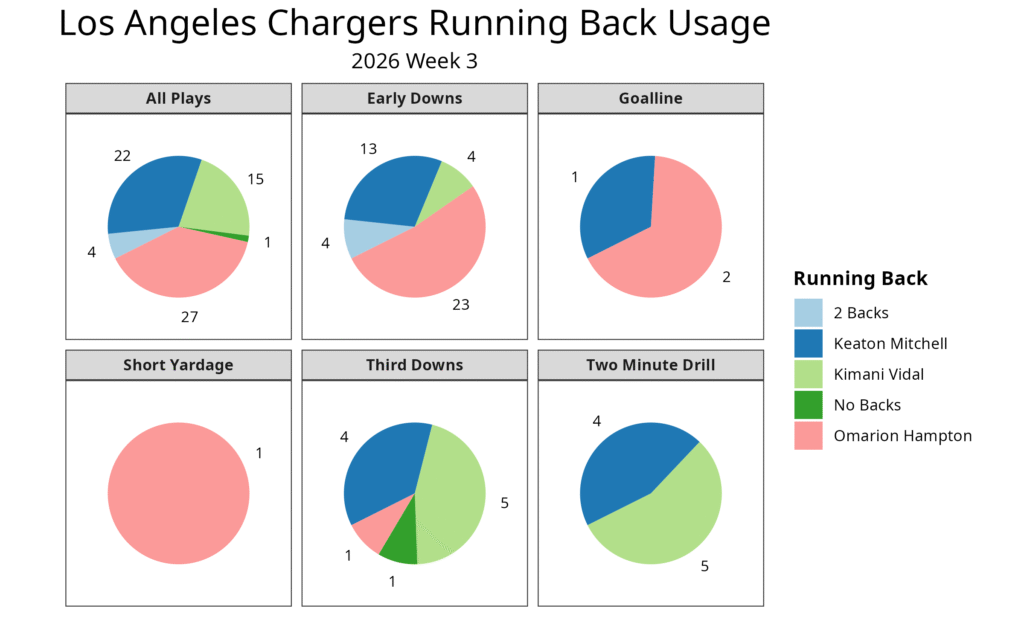
Los Angeles uses more of a committee in the backfield: All three of the Chargers’ running backs played between 24-42% of snaps.
The Chargers began the season with Omarion Hampton playing a dominant 74.3% of snaps on early downs. Keaton Mitchell saw more time in passing situations, leading Hampton to play 58.2% of snaps in Week 1. In Week 2, Kimani Vidal mixed in a little more in passing situations, and Hampton’s snap rate remained high on early downs.
This week, Vidal worked in even more, leaving Hampton to barely be on the field in passing situations. Mitchell played 38.6% of the early-down snaps, up from 23.7% over the first two weeks. Mitchell was also the more impressive running back in the box score. He totaled nearly as many rushing yards as Hampton despite receiving roughly half the carries, and he caught a touchdown pass.
Over three games, Mitchell has averaged more yards per carry and more yards after contact per carry. While Hampton has the better first-down rate, Mitchell owns the better clip of breaking 5-or-more-yard runs, and Mitchell’s number is more than double Hampton’s on 10- and 15-yard runs. We could see Mitchell’s touches continue to improve, making him a solid waiver option.
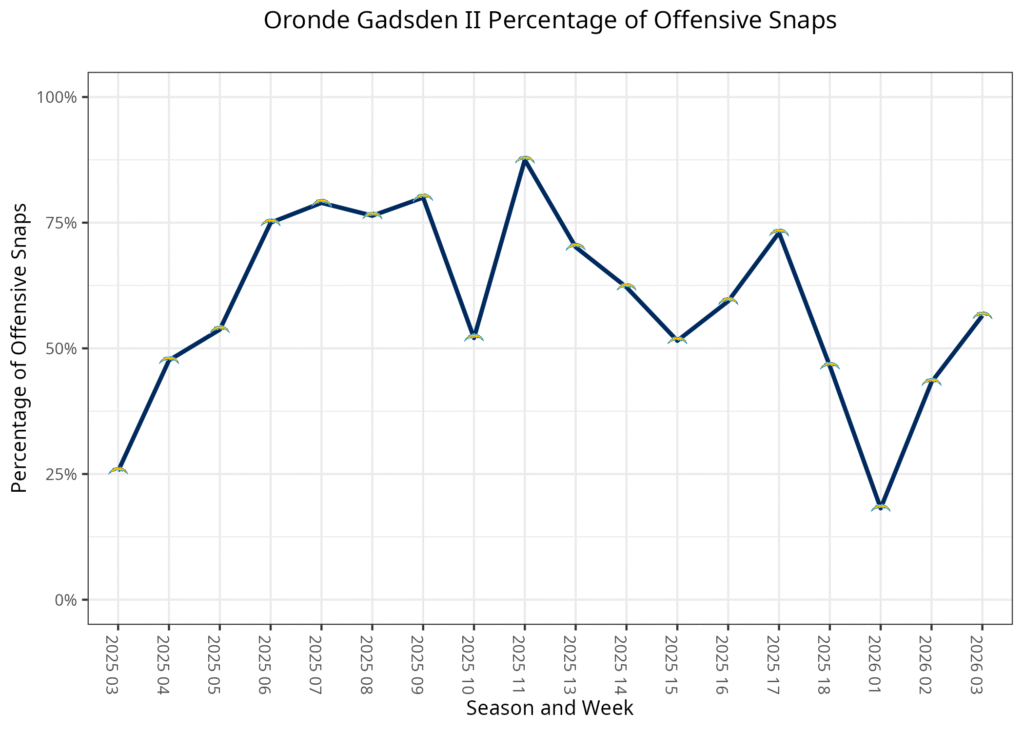
Chargers adjust down tight ends: Los Angeles focused its passing game on wide receivers down its top two tight ends.
The Chargers began the season with David Njoku and Charlie Kolar as their two top tight ends, with Njoku playing more on third downs, Kolar on early downs and the two sharing 12 personnel. This left little room for Oronde Gadsden, who was considered a potential fantasy starter at the start of 2026 before Los Angeles made the two free-agent additions. However, Njoku suffered a knee and fibula injury last week, landing him on injured reserve, while Kolar endured a forearm injury, which kept him out of this game and will likely hold him out longer. In response, Los Angeles signed Hayden Rucci, who had experience in Mike McDaniel’s offense, and elevated Patrick Herbert, brother of Justin Herbert, off the practice squad.
The rotation was straightforward, with Gadsden taking 25 of 30 snaps out of 11 personnel, while Rucci handled 17 of 24 snaps out of 21 personnel. The two shared the field for all two-tight end sets, with Herbert only seeing one snap on offense out of 13 personnel.
This left Gadsden running a route on a respectable 73.7% of pass plays, but he was only targeted on 7.1% of his routes. He didn’t catch any of his targets. While there is still time to turn things around, Kolar will likely return in the next two or three weeks. This was supposed to be an opportunity for Gadsden to prove he deserves more playing time over the rest of the season, and that didn’t happen in this game.
Ty Johnson makes his 2026 debut: The Bills’ third-down back missed the first two games due to injury.
The Bills spent the first two weeks without their receiving running back. Frank Gore Jr. was a practice squad call-up to take over the third-down and two-minute drill duties. However, Gore didn’t dominate passing-down opportunities in the same way Johnson did, and also didn’t cut into snaps as much on early downs. This led James Cook III to play 85.2% of early-down snaps over the first two weeks, and Ray Davis cut into the passing-down work. Only Jonathan Taylor dominated early snaps more than Cook over the first two weeks of the year.
While Johnson played the clear majority of passing situations and caught four passes, Cook played 81% of snaps on early downs. Part of that was the fact that the Bills were playing from behind for a lot of the game and needed a fourth-quarter comeback. It wouldn’t be surprising if Johnson takes a higher percentage of early-down snaps in games where the Bills have a big lead. Of course, if the Bills hold a major advantage, Cook likely would have played a large role in that, so his fantasy managers shouldn’t worry about his touches even with Johnson back.

Miscellaneous Notes
- Bills wide receiver DJ Moore (shoulder) and Keon Coleman (ankle) were both questionable for this game, but each ultimately ended up playing.
- The Bills signed wide receiver Greg Dortch off their own practice squad on Friday after making him a call-up for the first two weeks. Rookie Skyler Bell was a healthy inactive, signaling his third straight absence.
- Los Angeles wide receiver Ladd McConkey was a full participant in practice all week after playing on a limited basis due to a rib injury last week. His playing time was consistent with other games where he has been healthy, mostly losing out in single-wide receiver sets.
- Chargers rookie wide receiver Brenen Thompson was inactive with a quadriceps injury. He was their top backup over the first two weeks, playing 22 snaps. Gary Jennings was also released, while the team signed Marquez Valdes-Scantling off its practice squad to be the top outside backup receiver.
- Chargers backup quarterback Trey Lance was questionable with a groin injury. Los Angeles signed DJ Uiagalelei as a precaution, but he was ultimately the emergency third quarterback.
Carolina Panthers @ Cleveland Browns
Chuba Hubbard dominates touches without Jonathon Brooks: The Panthers’ lead running back played 100% of snaps in the first half.
The Panthers have started the season with Hubbard as their clear starter and Brooks as his backup. Third-string running back Trevor Etienne has began the year on injured reserve, with Brooks joining him on Wednesday. Brooks underwent surgery for a core muscle injury, which is expected to keep him out at least six weeks. This left AJ Dillon as the backup running back, while Anthony Tyus III was elevated from the practice squad to be the third back.
Tyus didn’t play at all on offense, and Dillon didn’t see his first offensive snaps until the middle of the third quarter. While it wouldn’t be surprising if Dillon mixes in a little earlier going forward, Hubbard should receive enough volume to make him a must-start every week until Brooks returns, or until the Panthers find an option they are more comfortable with for their RB2.

Monitor Jalen Coker’s health: Coker left in the third quarter with a quad injury and didn’t return.
Carolina has used Tetairoa McMillan and Coker as its primary wide receivers, with Xavier Legette joining in 11 personnel over the first two weeks. Carolina was already hurting at wide receiver heading into this game, as Legette was inactive with a knee injury and Coker was questionable for the game with an ankle.
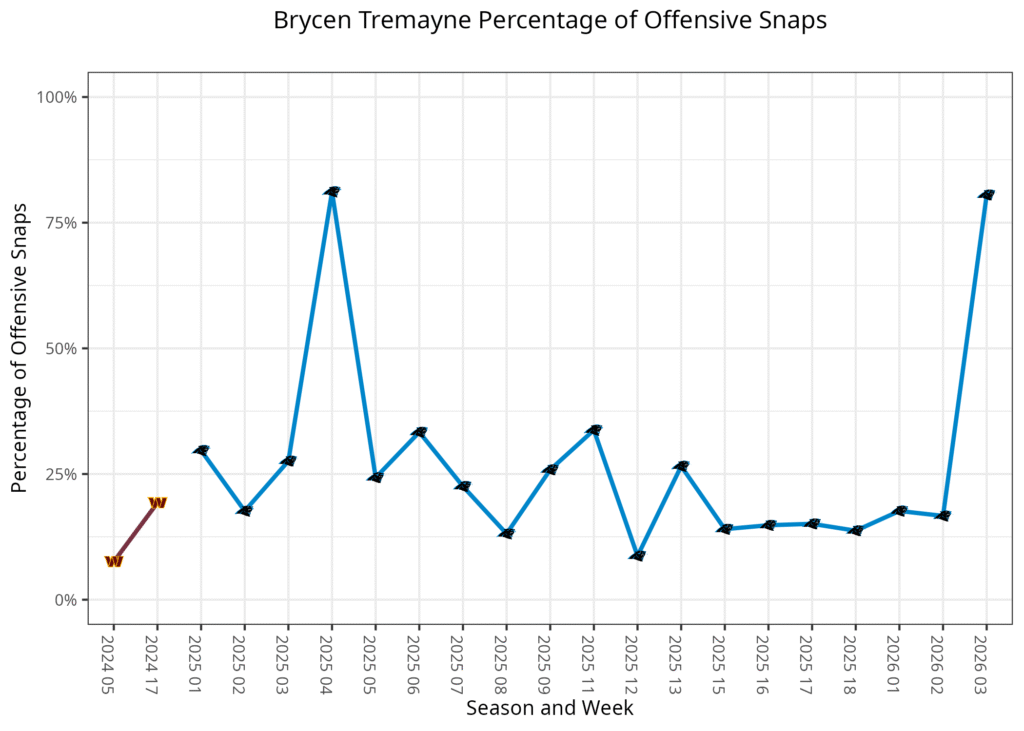
In the first half, Brycen Tremayne took over as the third receiver, with John Metchie III also mixing in. Metchie recently took over for Jimmy Horn Jr. as the Panthers’ backup slot option. Once Coker left with an injury, Tremayne became the second receiver in 12 personnel, while he and Metchie were more consistently on the field in 11 personnel. David Moore was a practice squad call-up for this game, and he became the fourth receiver.
Despite what happened in this game, if the injury to Coker is serious, then Legette would be the player to pick up off the waiver wire. He was limited in practice on Friday and was questionable going in, making it unlikely Legette’s injury is long-term. He’s been ahead of Tremayne when healthy and would likely take on a full-time role if Coker misses time.
Monitor Mitchell Evans’ health: The Panthers backup tight end suffered a right arm injury in the fourth quarter and didn’t return.
Carolina has spent the first two weeks with Tommy Tremble and Evans often playing in 12 personnel, Darren Waller as the third-down option and a rotation of the three players in 11 personnel on early downs. That continued in this game, though the Panthers played 11 personnel more often and trusted Waller for a higher percentage of 11 personnel snaps, giving Waller more time and less to Tremble and Evans.
After Evans’ injury, Waller played two snaps in 12 personnel. If Evans injury is serious and he starts to miss time, we could see an uptick in snaps by Waller. Waller’s route participation rate and targets per route have increased each week. While his targets per route is unlikely to augment much more, an uptick in route participation rate would turn Waller into a fantasy starter as long as he stays healthy.

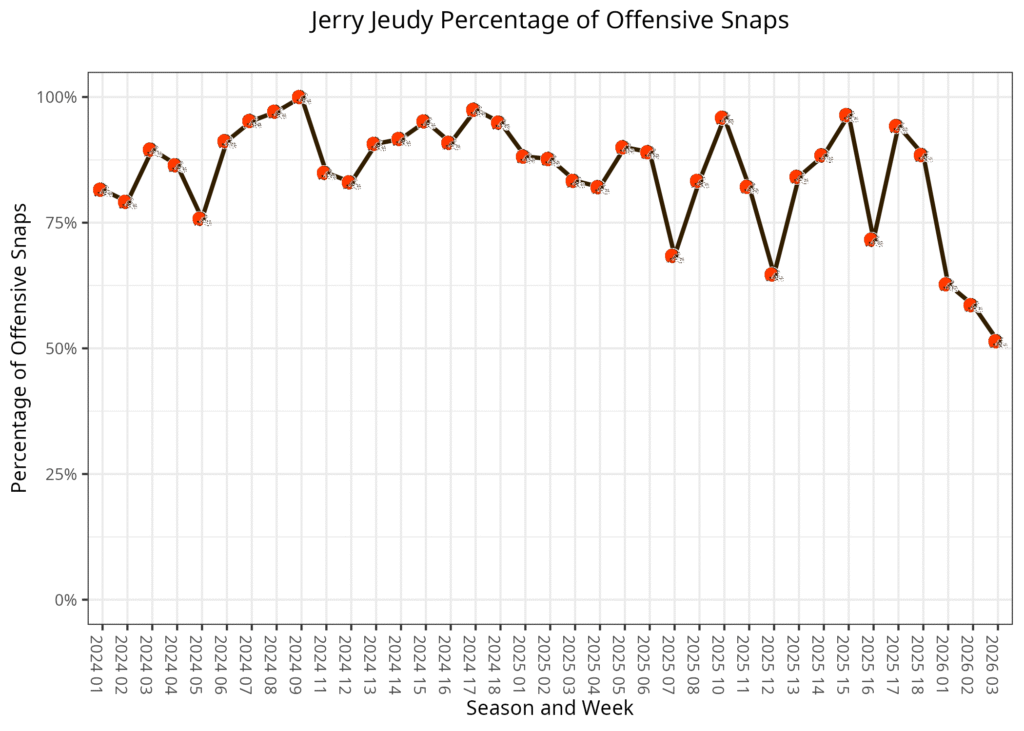
KC Concepcion Jr. becomes a full-time starter: The rookie has fully overtaken Jerry Jeudy in 12 personnel.
Denzel Boston has been the Browns’ X receiver all season, playing over 90% of snaps in 11 and 12 personnel and the majority of 13 personnel snaps, giving him a 91.1% snap rate on the season. Concepcion held a slight lead over Jeudy for the second spot over the first two weeks. Concepcion played 85.5% of snaps in 11 personnel, but only 42.4% in 12 personnel. Jeudy was playing 54.5% in 12 personnel, but only 69.6% in 11, losing some snaps primarily to Tylan Wallace. This rotation left Concepcion at a 67% snap rate and Jeudy at 60.6%.
This week, Concepcion was more frequently on the field in 11 personnel at a 95.8% rate. Most notably, he played 83.3% of the time 12 personnel, compared to 16.7% by Jeudy. Wallace suffered a right leg injury on a special teams play late in the fourth quarter, so it’s possible Jeudy will occupy a higher rate of 11 personnel going forward.
Concepcion only caught two passes for nine yards but was tied for the team lead in targets. He is a clear buy-low option right now, as the Browns believe he is ready for more, and it just didn’t work out in the box score this week.
Miscellaneous Notes
- Panthers tight end Ja’Tavion Sanders was a healthy inactive, his third straight absence.
- Deshaun Watson briefly left the game due to injury but was able to return.
- Quinshon Judkins‘ snap rate fell this week, likely because the Browns ran more plays in Week 3 than the last two. His total number of snaps remained similar to the previous two weeks.
New York Jets @ Detroit Lions
Monitor Breece Hall’s health: The Jets’ lead running back left in the fourth quarter with a thigh injury and didn’t return.
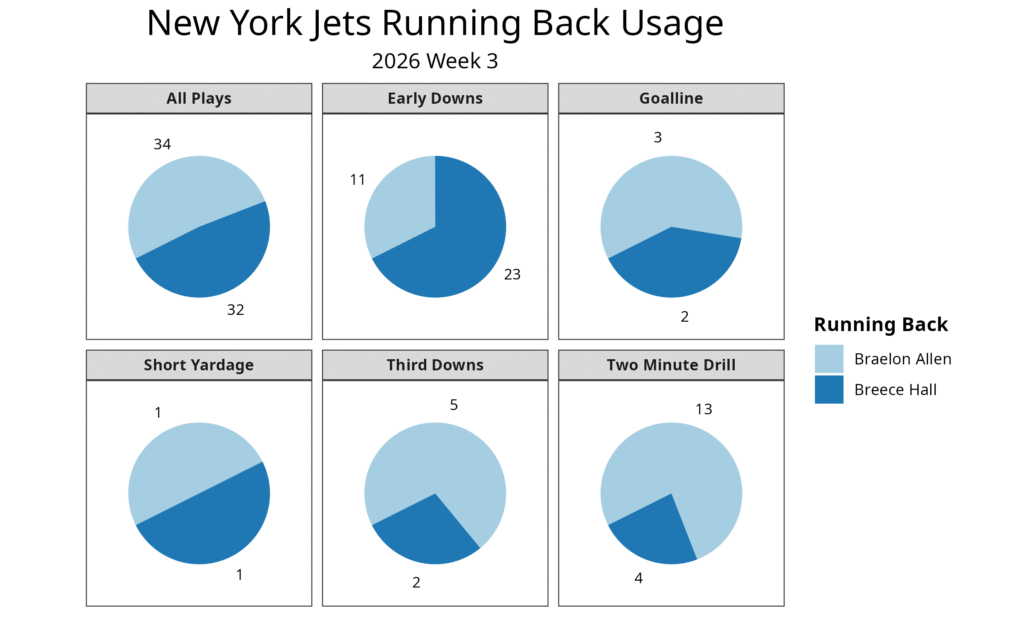
New York has only used two running backs all season in Hall and Braelon Allen. Hall has been the primary early-down back and Allen the primary third-down back. The two have pretty evenly split the two-minute drill, short-yardage situations and goal-line snaps over the first three weeks.
Hall held a clear lead over the first three quarters, with 24 snaps to 14 by Allen, including a big advantage in carries at 10 to one. Hall exited early in the fourth quarter, with Allen taking the rest of the snaps over the game. Allen would be the lead back if Hall misses any time, but Isaiah Davis would likely mix in as a receiving back.
Allen was already a solid waiver-wire target, given how much playing time he was receiving and his handcuff value. Now with Hall injured, Allen becomes one of the top waiver wire options of the week.
Jets adjust without most of their wide receivers: New York started the game without four of its top-six receivers and ended the game without five of six.
New York began the season with Adonai Mitchell as its X receiver, Garrett Wilson the Z and Omar Cooper Jr. as the slot in 11 personnel. Isaiah Williams, Tim Patrick and Arian Smith were the backups. Patrick landed on injured reserve before Week 1 and Cooper after Week 1. Smith is out for the season after tearing his ACL last week.
Mitchell was questionable for this game with a finger injury but was ultimately inactive, leaving New York only two of its top-six receivers. Malik McClain was signed to the 53-man roster on Wednesday, Jamaal Pritchett was added on Saturday and Sterling Shepard was a practice squad call-up.
Williams, who typically only plays in the slot, became a full-time starter for New York. Shepard was the primary player to join in three-receiver sets. McClain also rotated in significantly in 11 personnel. This meant Williams played much more Z receiver than usual, including in 11 personnel, where Shepard generally played in the slot. This also meant Wilson lined up more at X receiver than he had earlier this season.
Wilson was the only Jets wide receiver with multiple receptions, catching 10 passes for 107 yards and a touchdown. However, he stayed down after a hit at the end of the game, but was able to walk off under his own power. The game was over shortly after the injury, so it is difficult to know the current extent of the injury.
Even if Wilson misses time, Wilson and Mitchell are the only Jets wide receivers to seriously consider off the waiver wire.

Kenyon Sadiq breaks out for New York: The rookie tight end received an increased role with Mason Taylor out.
The Jets have used a heavy four-man rotation at tight end this season between Mason, Sadiq, Jeremy Ruckert and Jelani Woods. All four have played at least 10% of snaps in 11 personnel on early downs and on third downs. Likewise, all four have played at least 40% in 12 personnel. Taylor suffered a thumb injury last week, giving the Jets’ first-round rookie an opportunity to prove he deserves more playing time going forward.
New York continued deploying a three-man rotation. It was primarily Sadiq in 11 personnel and Ruckert and Woods in 12 personnel. However, Sadiq still played 47.6% of 12 personnel snaps, but also missed out on 11 personnel snaps. He only ran a route on 58.1% of pass plays, which is less than ideal, but was able to play so well thanks to a 32.0% target rate.
There are a lot of variables that will impact Sadiq’s fantasy value going forward. If he stays in this role, his target rate will likely decline slightly, making it hard to rely on him for fantasy value. However, even if Taylor returns next week, New York might decide to unleash Sadiq with more playing time because he performed so admirably. The injuries at wide receiver will also factor into Sadiq’s playing time.
Ultimately, Sadiq is worth picking up in leagues where he is available, as he could be one of the top two or three target earners for the Jets going forward.
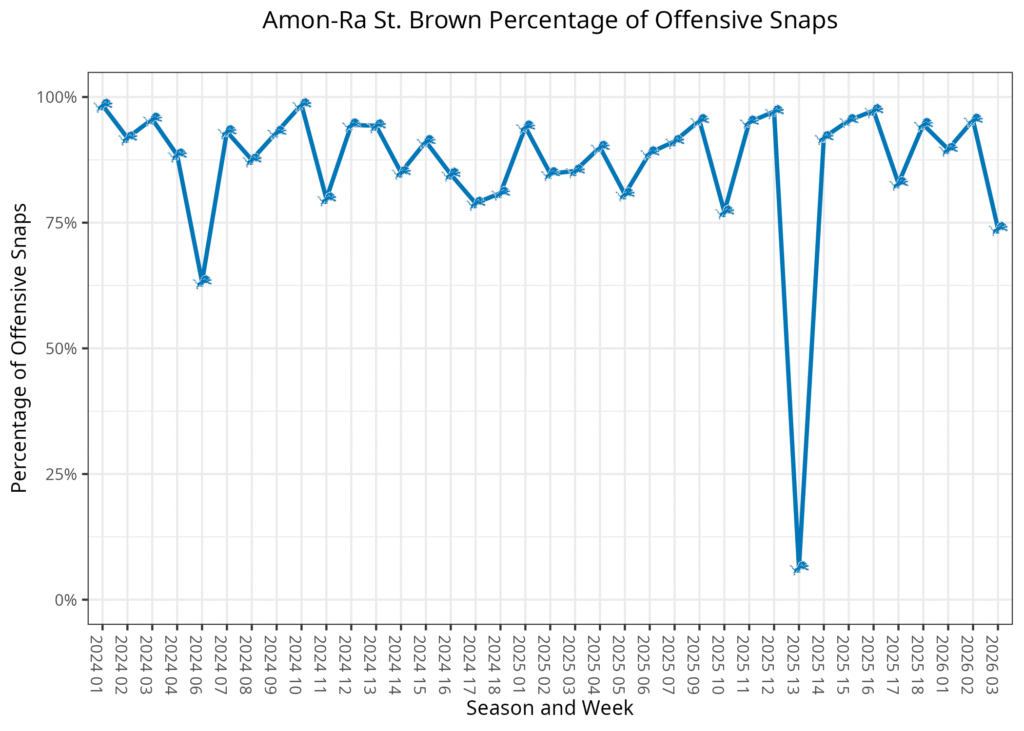
Lions wide receivers see a dip in playing time: Jameson Williams and Amon-Ra St. Brown both fell under an 82% snap rate.
In the first two games, St. Brown and Williams played 100% of 11 and 12 personnel snaps. The two only lost time in 13 personnel, giving both wide receivers over a 90% snap rate over the first two weeks. Isaac TeSlaa was the only other Lions wide receiver to see a snap over the first two weeks, consistently playing in 11 personnel and taking some snaps in 13 personnel.
This week, TeSlaa received snaps in 12 personnel for the first time this season, and Tay Martin garnered his first offensive snaps of the season. Detroit tight end Tyler Conklin was a healthy inactive after suiting up the last two weeks. This left Jackson Meeks as the Lions third tight end. Meeks is a hybrid wide receiver, so there were plays with Meeks as part of 13 personnel where he could be used like a receiver.
This left both wide receivers at an 80.6% route participation rate. St. Brown was at 95.3% heading into the week, and Williams 91.8%. Neither wide receiver had their best game from a fantasy perspective. It will be worth monitoring if Detroit continues to play around with 13 personnel, as that would impact the playing time of its top receivers.
Miscellaneous Notes
- Jets fourth-string running back and returner Kene Nwangwu was inactive for a third straight game with a back injury.
- New York elevated Jason Sanders from the practice squad for the third straight week. If the Jets want to stick with Sanders, they will need to sign him to their 53-man roster. Blake Grupe was a healthy inactive for a second straight week.
- The Jets signed quarterback Will Levis to the practice squad on Tuesday.
Houston Texans @ Indianapolis Colts
Indianapolis adjusts without Alec Pierce: The Colts’ X receiver landed on injured reserve this week.
The Colts have started the season by having Pierce rotate with Laquon Treadwell at X, moving Josh Downs to Z in 12 personnel and slot in 11 with Keenan Allen playing Z in 11 personnel. Ashton Dulin has been the fifth wide receiver.
Pierce was placed on injured reserve this week with a heel injury, while Dulin was inactive for a second straight game with an ankle injury. The Colts signed Darius Slayton, who has significant experience with quarterback Daniel Jones from their time together with the New York Giants, but they opted to leave him inactive this week. They also had Deion Burks, signed Anthony Gould to the 53-man roster and elevated Nick Westbrook-Ikhine from the practice squad.
Without Pierce, Dulin or Slayton, Treadwell was the Colts’ clear X receiver in this game, leading the team in offensive snaps. The Colts surprisingly made other adjustments to their wide receiver rotation. Downs played 88.6% of 12 personnel snaps over the first two weeks, and that dropped to 50% this week, with Allen and Burks getting more involved. Indianapolis primarily used its X receiver in 13 personnel over the first two weeks; Allen was the receiver for most 13 personnel snaps this week.
The Indianapolis passing game went almost entirely through Downs, Allen and tight end Tyler Warren. It’s possible Downs’ decrease in snap was because he needed more breaks with how often he was getting targeted. Allen becomes more viable in this role, but the 13 personnel splits will be worth monitoring once Slayton starts playing.

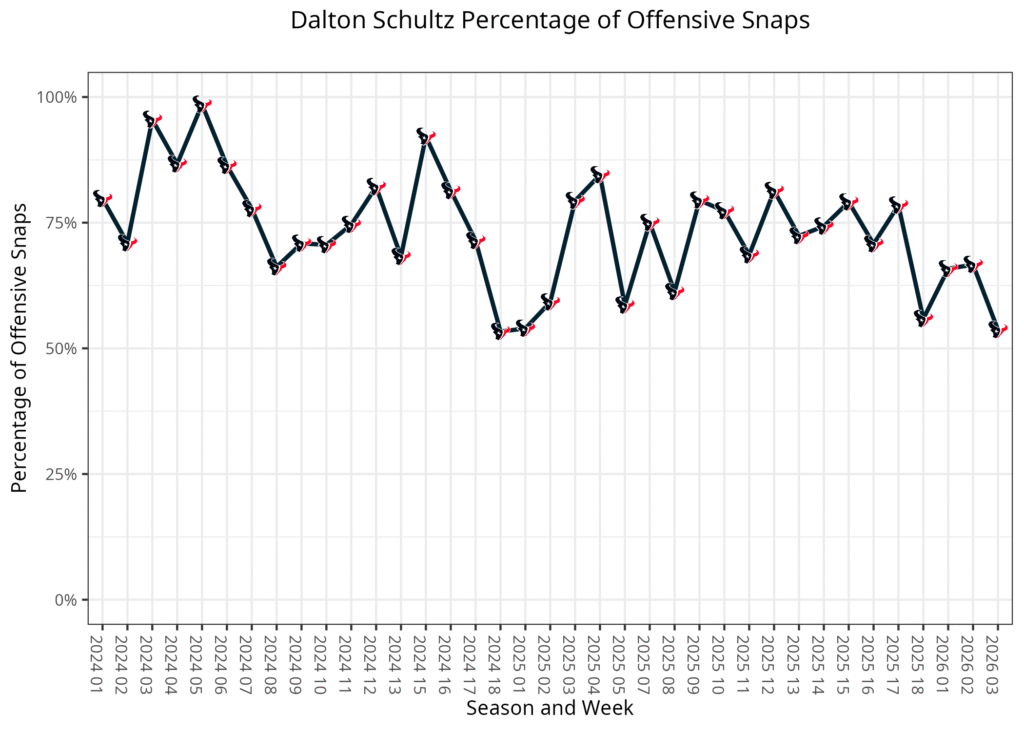
Foster Moreau out-snaps Dalton Schultz: While Schultz posted elite fantasy production in Week 2, his value over the rest of the season is in trouble.
Schultz was the clear top tight end for Houston last season, but that was in part because of injuries to Houston’s backup tight ends. Houston addressed the position this offseason, adding Moreau in free agency and drafting Marlin Klein. Cade Stover is also healthier this season.
The Texans’ tight end usage has been fairly consistent all season; Schultz has played 71.4% of 11 personnel snaps on early downs and 90.7% on third downs, but only 15.4% in 12 personnel and 58.3% in 13 personnel. Schultz was able to have a lot of fantasy value the first two weeks because Houston was often playing from behind, facing Josh Allen and Joe Burrow-led offenses. This week, the Texans were within a touchdown throughout the game.
Last week, Houston ran 60 plays in 11 personnel, and 10 in 12 or 13. This week, it was 28 in 11 personnel, and 26 in 12 or 13. That led to a decrease in snaps for Schultz. His route participation rate was the lowest of the season, and his target rate also happened to dip.
We could see Schultz’ target rate bounce back, but it’s also possible that Schultz’s snap rate will decline even further. If the Texans can gain and hold a lead, we might see them use even more 12 and 13 personnel, which will likely shift Schultz’s snap rate below 50%. We shouldn’t trust him in fantasy starting lineups going forward.
Miscellaneous Notes
- Colts running back DJ Giddens was inactive, his third straight absence. The Colts have stuck with two running backs all season.
- Indianapolis kicker Spencer Shrader briefly left the game with a groin injury, but was able to return.
- Houston continues to use the same running back rotation of David Montgomery taking the first two drives, and then a rotation by possession. There was slightly more rotation of a running back out if the drive has gone on too long. Montgomery’s series generally lasted longer than Marks’, leading Montgomery to play a higher percentage of snaps compared to normal.
- Texans wide receiver Nico Collins missed his second straight game with a hamstring injury. Lewis Bond was a practice squad call-up to give Houston more depth at wide receiver.
- Wide receiver Xavier Hutchinson exited the game with a shoulder injury late in the fourth quarter. He was able to return for a few plays at the end of the game.
- Kayshon Boutte saw his snap rate increase in 11 and 12 personnel, playing over 80% of the time in both situations after seeing under 80% last week. However, his overall snap rate decreased due to the uptick in 13 personnel.
- Texans tight end Brevin Jordan didn’t dress (coach’s decision), his third straight absence.
New England Patriots @ Jacksonville Jaguars
Patriots tweak running back rotation: This was the first game of the season where both running backs were healthy and neither lost a fumble.
TreVeyon Henderson missed Week 1, leading Rhamondre Stevenson to a dominant role. In Week 2, Stevenson fumbled on the first drive, prompting Henderson to dominate snaps over the rest of the game. This week, Stevenson got the start. The two were evenly split throughout the game on early downs, but Stevenson played both the passing downs and short-yardage and goal-line situations.
Stevenson tallied more yards per carry and was more involved in the passing game. Based on this game, Stevenson will have the most fantasy value in the short term. While he didn’t score a touchdown this week, he will be the one scoring touchdowns more often than not.
The Patriots’ offense doesn’t look as good as last season, and they will need to play better for either to have a lot of fantasy value going forward. Luckily, the Patriots have a much easier remaining schedule compared to what they’ve faced so far, so Stevenson should be considered a buy-low option.

Brian Thomas Jr. falls in the Jaguars’ wide receiver rotation: Thomas played under 40% of snaps for the second time in three weeks.
The Jaguars’ wide receiver situation seemed complicated heading into the season, with Parker Washington, Jakobi Meyers and Thomas, as well as the return of Travis Hunter. Hunter hasn’t been much of a factor on offense this season.
It was clear in Week 1 that Washington and Meyers were the top two receivers, although the gap between them was notably wide, in part because Thomas dealt with injuries in Week 1. All three played over 90% of 11 personnel snaps in Week 2. In 12 personnel, Meyers played 95.5% of snaps, Washington 72.7%, and Thomas only 9.1%, making it clear Thomas was the third option.
This week, Washington’s snap rate increased in 12 personnel to 87.5%. Thomas didn’t take a snap in 12 personnel, with rookie Josh Cameron being the primary backup. Cameron has carved out a role as the wide receiver in 13 personnel. Thomas’ snap rate in 11 personnel also took a hit, moving to 76.7%.
The Jaguars didn’t need much out of their passing game to win, but Meyers and Washington led the team in yards while Meyers, Washington and Cameron all scored touchdowns. It’s one thing for Thomas to be the third option behind two very talented wide receivers, but the fact that a sixth-round rookie is playing ahead of Thomas in two personnel groupings and cutting into his playing time in a third could be a sign Thomas’ playing time in Jacksonville could be numbered.

Miscellaneous Notes
- Quinn Ewers was the Jaguars’ backup quarterback for the first time this season. During the first two weeks, Nick Mullens was a practice squad call-up to be QB2.
- Bhayshul Tuten’s playing time has been remarkably consistent this season, playing between 48.4%-50.0% of offensive snaps each of the first three weeks.
- Jaguars running back LeQuint Allen Jr. was limited in practice all week with a hip injury, which he’s been dealing with all season.
- While Jaguars sixth-round rookie wide receiver CJ Williams was a healthy inactive for a second straight week, fifth-round rookie tight end Tanner Koziol was active for the first time.
- New England tight end Eli Raridon couldn’t play due to a thigh injury. He was limited Wednesday, downgraded to did not practice Thursday and didn’t practice Friday. This left Cameron Latu and Tanner Arkin as the backup tight ends.
- The Patriots pulled some starters for the final 10 snaps, including quarterback Drake Maye, running back Rhamondre Stevenson and tight end Hunter Henry. Henry’s playing time was normal prior to garbage time. It was surprising that none of the wide receivers were also pulled from the game.
- Corey Kiner wasn’t involved on offense until the final eight minutes of the game.
Kansas City Chiefs @ Miami Dolphins
Monitor De’Von Achane’s health: Achane suffered a knee injury early in the first quarter, and after the game, head coach Jeff Hafley said it didn’t look good.
Achane played 80.7% of offensive snaps over the first two weeks, which was the second-highest rate among running backs behind Jonathan Taylor. Miami came into the season with Ollie Gordon II and Jaylen Wright as the backups, and they were the reserves last season.
Gordon started 2025 as RB2, playing 77 snaps over the first six weeks. Wright became healthy in Week 7, but Gordon out-snapped Wright 93-37 over a seven-week span. Yet Wright out-snapped Gordon 90-53 over the final five weeks, which included Wright running more than Achane during that time.
In Week 1 of this season, both played four snaps, but Gordon’s snaps came early in the game, and Wright’s were in the fourth quarter. In Week 2, Wright played three snaps on the first two drives to two by Gordon, but then Wright left with a stinger and foot injury and was inactive for this game.
Miami unfortunately didn’t activate a running back from the practice squad, leaving it with two backs. Achane only played four snaps, leaving Gordon as the last man standing. He played 61 snaps. Fullback DJ Herman took seven snaps at halfback, and wide receiver Malik Washington handled five snaps. Miami used some empty formations. There were two points where the game book noted Gordon leaving due to injury, but he returned not long after.
Achane’s injury appears to be serious, making Gordon the clear top running back to add off the waiver wire. However, there is a chance that Wright is the better option, making Wright another back to pick up. Miami notably traded for Jarquez Hunter in August, and Hunter is on the practice squad, so there is a chance he gets involved. Carlos Washington Jr. is also on the practice squad.
If your team is desperate for a running back, then it makes sense to add both Gordon and Wright. But in most leagues, since Wright will likely be much cheaper, it might make more sense to gamble on him.

Miami adjusted without Caleb Douglas: The Dolphins’ third-round rookie was inactive due to injury, opening the door for their other third-round newcomer.
Miami started the season with Douglas and Malik Washington as its top two receivers, with both playing above 85% of snaps. Chris Bell and Kevin Coleman Jr. have been the backups, splitting time in 11 personnel. Douglas and Bell are best suited to play X, while Washington and Coleman are optimal for the slot, which has led to many different combinations of where the receivers have lined up. Douglas suffered an ankle injury last week, leading him to be inactive for this game. This allowed veteran Jalen Tolbert to be active for the first time this season.
Bell and Coleman were more consistently on the field in 11 personnel, as they and Washington all played over 86% of snaps in that personnel grouping. Washington remained one of the primary receivers in 12 personnel, with Bell also taking a majority of snaps.
This left Bell leading the team in receiving yards at 67 off four receptions, but Washington and tight end Greg Dulcich had fine days with five receptions each. While the Dolphins’ running backs will be the focus of the waiver wire given De’Von Achane’s injury, you can make an argument for all of the Dolphins receivers. Douglas, Washington, Bell and Dulcich are all generally available and will need to be the focal point of the offense going forward.

Rashee Rice bounces back: Rice caught seven passes for 88 yards, leading all Kansas City wide receivers.
Rice was one of the most concerning fantasy receivers over the first two weeks. He only caught two passes in Week 1 and hauled in four passes for 83 yards in Week 2; yet a lot of those yards came from the final play of regulation, where the Colts only cared about preventing a touchdown. Rice’s target rate was 7.4% in Week 1 and 13.9% in Week 2.
In Week 1, Rice only lined up in the slot 26.3% of snaps, which was notably lower than last year’s rate of 40%. In these last two games, he’s lined up inside on 38.1% and 37.5% of snaps, which brings his alignment usage much closer to last season. His average depth of target was 8.0 yards last week and 7.4 this week, which is a little higher than last season but still low for a typical wide receiver.
The big change this week was simply that the Chiefs targeted him more often, at a 40.9% rate, which was significantly elevated compared to the last two weeks. Chances are, that figure will decrease going forward, even if it falls to 30%. The Chiefs have barely used their young, backup wide receivers early this season, and they could be more involved later in the year. Kansas City is also the favorite to add Tyreek Hill mid-season.
For all of these reasons, Rice is a sell-high candidate.
Miscellaneous Notes
- Miami tight end Greg Dulcich’s playing time was similar this week to the last two, playing the majority of early-down snaps in 11 personnel, the clear majority on third downs and 100% of the two-tight end sets. However, his route participation rate rose to 71.4% this week after failing to hit 60% the first two weeks.
- Dolphins rookie tight end Justin Joly was active for the first time this season, giving Miami four tight ends.
- Chiefs third-string running back Brashard Smith received snaps on offense for the first time this season. All of his plays involved Smith lining up at wide receiver and Kenneth Walker or Emmett Johnson lining up in the backfield.
- Kansas City used more 12 and 13 personnel than usual, leading to more snaps and opportunities for Noah Gray.
- Kansas City tight end Jared Wiley was a healthy scratch, his third straight absence.
Tennessee Titans @ New York Giants
Devin Singletary is a healthy inactive for New York: Singletary had played 31.5% of the Giants’ offensive snaps over the first two weeks.
New York generally used a two-man rotation at running back, with Cam Skattebo as the early-down back and Singletary as the receiving back. Najee Harris mixed in for eight snaps, all in the second quarter of Week 2, while Tyrone Tracy Jr. has played three offensive snaps. While it wasn’t all that surprising to see New York decide to have three active running backs instead of four, it was eye-opening that Singletary was inactive rather than Tracy.
This was part of a general trend by New York to keep its best players on the field. Skattebo’s playing time has been remarkably consistent on normal early-down situations, sitting right around two-thirds of snaps. This week, it was Harris taking the other third. The change was that Skattebo played 100% of late-down and two-minute drill snaps after not taking any two-minute drill snaps the first two weeks and only 31.6% of third-down snaps.
Skattebo ran 20 times for 60 yards and caught three passes for 40 yards. Skattebo only had three games with three or more receptions as a rookie and has reached that mark twice in the last six days.
The only concern is that the Giants’ offense was more effective with Harris as a runner. Harris averaged 5.8 yards per carry compared to 3.0 by Skattebo. That could lead to Harris seeing more carries going forward. However, if Skattebo continues to be used the same way he was in this game, that gives him top-10 potential at running back.

Isaiah Likely becomes a buy-low option: Likely had his worst statistical game but his best utilization.
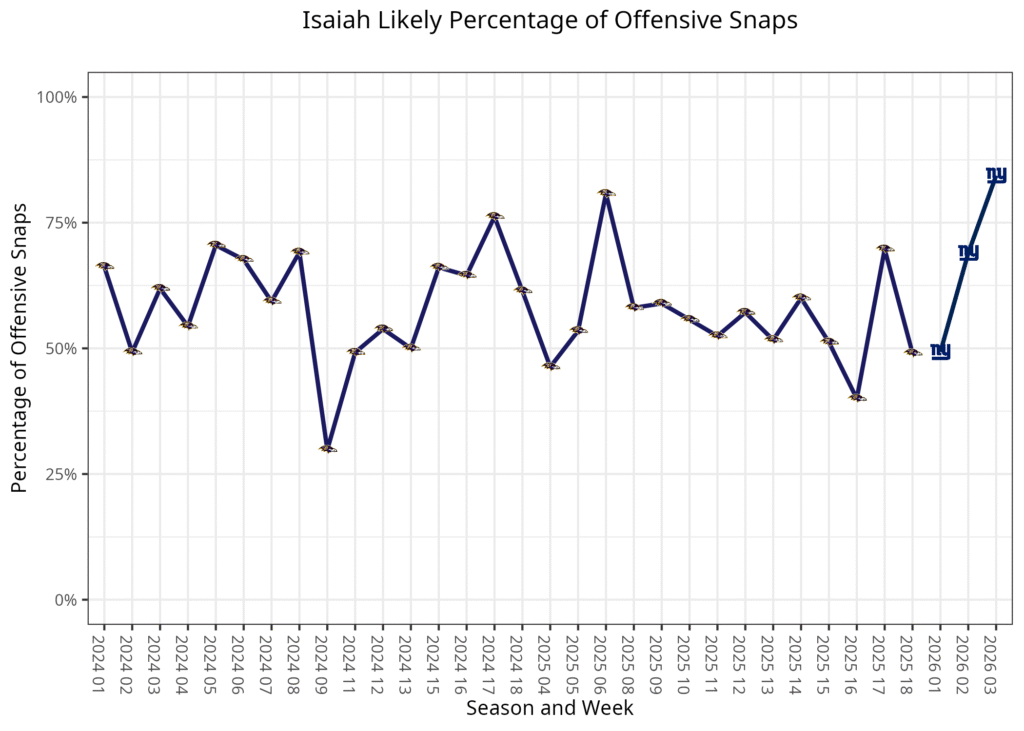
Likely spent the first four seasons of his career in a three-man rotation with the Baltimore Ravens, playing with Mark Andrews and Charlie Kolar. Likely was similarly in a mix the first two weeks. He only played 58.3% of snaps, with Theo Johnson and Chris Manhertz both seeing at least a 33% snap rate. While Likely was consistently on the field on third downs, he was in a constant rotation on first and second downs.
This week, Likely stayed on the field at a much higher rate. He played 100% of snaps in 11 personnel on third downs, 75% in single-tight end snaps on early downs and 88.5% of snaps in 12 personnel. This was particularly noteworthy because the Giants held a lead the entire game. When a team typically has a lead in these kinds of rotations, it’s the blocking tight ends who see more playing time than usual, and the receiving tight end less. This suggests that New York simply plans on having Likely be a bigger part of the offense.
His route participation rate has grown from 67.6% to 85.3% to 92.3%. This puts Likely at a 90.9% rate on the season, placing him among the top five tight ends. Mix that with his high target rate, and Likely should have a lot of opportunities this season. His box score was limited, largely because the Giants only attempted 22 passes, but there should be brighter days ahead for his fantasy value as New York plays from behind.
The Titans adjust their running back usage: After using their backs more interchangeably early in the season, the Titans’ backs had clearer roles this week.
The Titans kept their same top two running backs in Tony Pollard and Tyjae Spears. Over the first two weeks, Pollard played 64.1% of snaps on early downs, which was a notable decrease from last season, when he played at least two-thirds of the early-down snaps in all but two games. Spears was rotating in more on early downs, but Pollard was involved more on third downs and during two-minute drills compared to games last season where Spears was healthy.
This week, Pollard’s snap rate was nearly identical to the first two weeks, at 53.4% to 53.3%. However, Pollard played 80% of snaps on early downs, and none of the third-down snaps. This was much more like a typical game for the Titans last season. This left Pollard with 17 carries for 74 yards, compared to three carries for five yards by Spears.
It’s worth noting Pollard missed some practice with an ankle injury, while Spears was questionable with a knee injury. Spears also left the game in the fourth quarter, was deemed questionable and was ultimately able to return. It’s unclear if the injuries impacted the running back usage.
However, if this split holds, it will be easier to put Pollard in starting lineups in weeks where the Tians should be competitive. It will also be tougher for Spears to have any fantasy value unless Pollard suffers an injury or is traded.

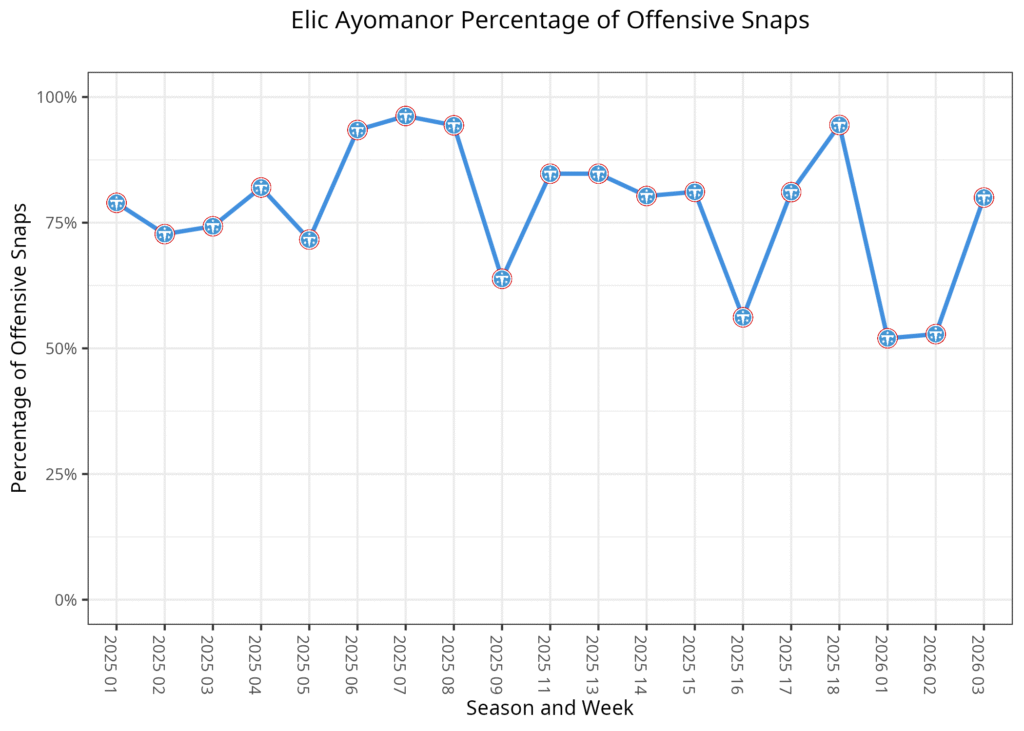
Elic Ayomanor takes over for Calvin Ridley: The two had competed for the Titans’ X receiver spot.
The Titans have been set all season with Carnell Tate as their Z receiver and Wan’Dale Robinson playing in the slot in 11 personnel. Most of their rotation came at X, where Ridley played 63.1% of snaps over the first two weeks compared to 52.4% by Ayomanor. There was a slight tendency for Ayomanor to play on pass plays and Ridley on runs, so their route participation rates were close to identical.
This week, Ayomanor played 80% of snaps to 33.3% by Ridley. This included Ayomanor playing 82.6% of snaps in 11 personnel and 69.2% in 12. Ayomanor caught one pass for 11 yards, while Ridley was held without a catch for the third time this season. Given the Titans’ 0-3 record, and the fact that Ridley will be 32 by the end of the year while Ayomanor is 23, it wouldn’t be surprising if Ayomanor remains the X receiver for the rest of the season.
It’s unlikely Ayomanor will have much value in redraft leagues unless the Titans’ offense improves, but Ayomanor could have a few big games throughout the season.
Miscellaneous Notes
- New York Giants starting quarterback Jaxson Dart was placed on injured reserve, and he is not expected to return this season. Jameis Winston was the starting quarterback for this game, and there are reports that New York plans on adding another quarterback sooner rather than later. Jake Haener was signed off the practice squad to be the team’s backup quarterback for now.
- Malik Nabers’ usage took several positive steps forward, seeing slight increases in snap rate in 11, 12 and 13 personnel, and his target rate was much higher than last week. However, he had a 1.0-yard average depth of target compared to a 20.5 last week.
- Braxton Berrios was a practice squad call-up for New York for a third straight week for his work at wide receiver and special teams.
- Titans running back Michael Carter was a practice squad call-up as insurance for Tyjae Spears, who was questionable with a knee injury. However, Spears was ready to play, so Carter was the rare call-up who was inactive.
- Tight end Gunnar Helm’s usage this week was nearly identical to the first two games. Helm played 81.6% of snaps and was targeted on 15.0% of his routes over the first two weeks. He played at an 81.7% snap rate and was targeted on 14.8% of his routes in this game.
Cincinnati Bengals @ Pittsburgh Steelers
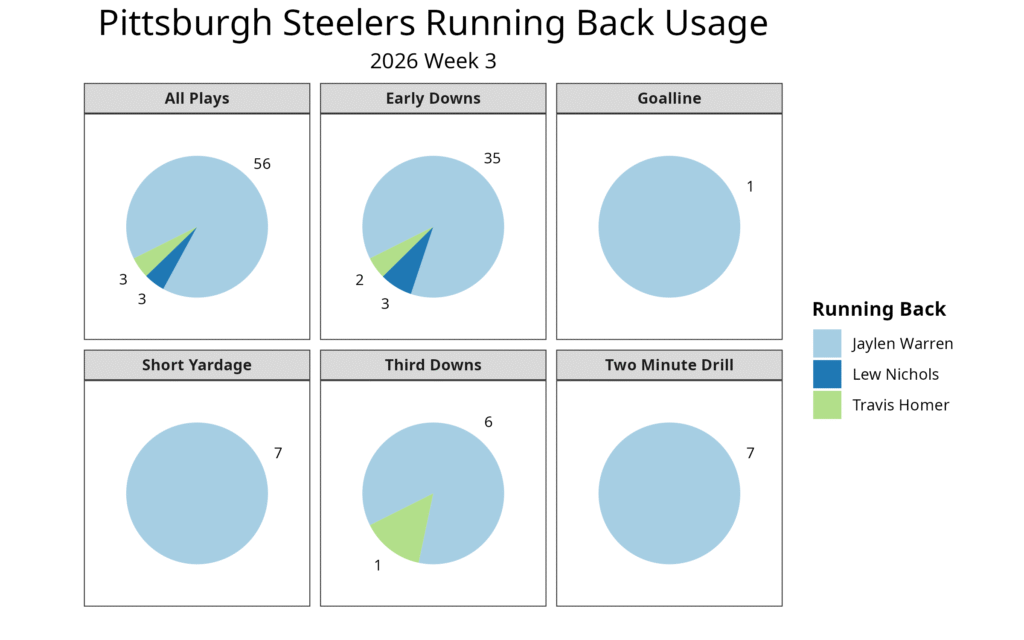
Jaylen Warren dominates in his first game as an every-down back: Rico Dowdle was inactive due to injury, giving Warren an opportunity to shine.
The Steelers have a two-man rotation between Warren and Dowdle, using them interchangeably. Dowdle suffered a toe injury last week, leaving Warren as the starter. Warren has spent his entire career in a two-man rotation, with Najee Harris for three seasons, Kenny Gainwell for one and Dowdle this year. This is the first time in Warren’s five-year career that his primary competition has missed a game. However, Warren also wasn’t 100%, as he was questionable with a shoulder injury.
In response, the Steelers signed Travis Homer to the 53-man roster, while Lew Nichols was a practice squad elevation. They also made seventh-round rookie Eli Heidenreich a healthy inactive.
Warren played 90.3% of snaps, with over 85% of snaps in all situations. He ran 17 times for 127 yards and caught three passes for 49 yards. Homer and Nichols took three snaps each as the backups.
Given that Warren and Dowdle had been used interchangeably, it’s easy for Pittsburgh to change their usage going forward if they want to. When some teams have a clear early-down back and prominent third-down player, even if one of the backs has a big game, they are unlikely to see a significantly increased role. This game can only mean good things for Warren’s fantasy value going forward, and not great things for Dowdle.
Roman Wilson’s drop cost him playing time: Wilson barely saw the field after a drop resulted in an interception.
The Steelers started the season with DK Metcalf and Michael Pittman Jr. as their top receivers, with Wilson joining in 11 personnel. Pittman missed last week with a foot injury, allowing second-round rookie Germie Bernard to see extended playing time. Pittman was back this week, so the Steelers went right back to their Week 1 rotation.
Wilson played in 22 of a possible 32 snaps in the first half, compared to five snaps by Bernard. Wilson was off to an excellent start, catching three passes for 60 yards and a touchdown over the first three drives with just four catches by the rest of the Steelers’ wide receivers. However, Wilson dropped a pass on the fourth drive, and when the ball ended up in the hands of a defender, it led to an eventual Bengals touchdown.
That was enough for Pittsburgh to make a change at halftime. Bernard took 12 of 30 snaps in the second half, Ben Skowronek handled eight and Wilson saw two. Bernard caught one pass for 14 yards, and Skowronek caught one for 23 yards and a touchdown in the first half.
It will be interesting to see if the Steelers will continue to punish Wilson next week despite his strong start to the game.

Monitor Colbie Young’s health: The Bengals’ rookie wide receiver suffered a knee injury and was quickly ruled out.
The Bengals have spent the last three seasons with a straightforward wide receiver rotation, with Ja’Marr Chase and Tee Higgins as the starters and Andrei Iosivas as the third receiver joining for 11 personnel. Iosivas had minimal competition for playing time, but Cincinnati brought in fourth-round rookie Young and CFL receiver Dohnte Meyers. Iosivas suffered a thumb injury and landed him on injured reserve, giving the young wide receivers an opportunity to step up. Ke’Shawn Williams was also active for the first time this year.
Young received the first chance over Meyers, but he suffered his injury on the first play. He was initially ruled doubtful, which isn’t a great sign, and then was declared out. This left Meyers as the third wide receiver for the rest of the game. He took the rest of the 11 personnel snaps, and also subbed in for Higgins for three snaps in 12 personnel.
While Meyers isn’t worth rostering in most leagues, he is an injury to Chase or Higgins away from being an every-down receiver in this offense. In leagues where most third wide receivers are rostered, Meyers is someone worth taking a chance on.
Miscellaneous Notes
- Steelers tight end Darnell Washington played a little more than usual in 11 personnel, leading to a 56.8% route participation rate. His route participation rates have fluctuated in the past, so it will be worth seeing if these trends continue before considering Washington off the waiver wire.
- Steelers wide receiver Michael Pittman Jr. was back in the lineup after missing a week due to a foot injury.
- Bengals backup tight end Tanner Hudson was a practice squad call-up for this game. He replaced Jack Endries as their fourth tight end, as Endries was a healthy inactive.
- Cincinnati running back Samaje Perine and tight end Mike Gesicki left the game briefly due to injuries, but both were able to return.
Seattle Seahawks @ Washington Commanders
Emanuel Wilson leads the Seahawks in rushing attempts: Seattle used a three-man rotation at running back, with Wilson paving the way on early downs.
In Week 1, Jadarian Price was the early-down back, George Holani was the backup and third-down back and Wilson came in for some short-yardage situations. In Week 2, Wilson became the primary backup on early downs, taking 43.2% of the early-down snaps to 52.3% by Price.
This week, Wilson received a slightly higher rate of early-down snaps at 47.7%. Holani also cut into Price’s playing time on early downs. This appeared to be the plan from the start, as Wilson played eight first-quarter snaps to four by Price. The first-round rookie only appeared on 10 of 52 snaps over the first three quarters. Eight of his 19 snaps in the game came in the final five minutes of the game. Price was on the injury report at the start of the week, but was a full participant in practice at the end and wasn’t given a game status.
Despite this, Price still led the team in rushing yards with 15 over five carries. Wilson ran nine times for 14 yards. It will be very difficult to trust Price in starting lineups next week. After Week 4, the Seahawks face the San Francisco 49ers, Denver Broncos and Kansas City Chiefs. Zach Charbonnet should be returning some time in this span. It’s possible Price can’t be in fantasy starting lineups going forward.

Treylon Burks works his way back up the depth chart: Burks scored a touchdown for Washington and has seen his route participation rate increase significantly each week.
The Commanders have a crowded wide receiver room, but Burks appeared to be near the top of the depth chart in the preseason. He played 100% of snaps with the starters along with Terry McLaurin, with Stefon Diggs only joining in 11 personnel. McLaurin has spent the season as the top wide receiver in terms of playing time, while Diggs has primarily played in 11 personnel. However, there have been several players in the mix for the third receiver spot.
Burks was surprisingly a healthy inactive in Week 1, with Dyami Brown as the third receiver, Antonio Williams mixing in significantly and Jaylin Lane also getting involved. Burks was active in Week 2 and he surpassed Lane on the depth chart, running a route on a quarter of Washington’s passing plays.
This week, Burks moved ahead of Brown. Antonio Williams was third in terms of snap rate, but that was largely thanks to run plays. Burks wasn’t far behind in snap rate, but he ran a route on 54.3% of pass plays. Williams and Brown were both at 28.6%. The fact that Burks has re-emerged will make it more difficult for Williams to become fantasy-relevant in the near future.
Miscellaneous Notes
- Washington starting quarterback Jayden Daniels was inactive with a left elbow injury. It’s possible Daniels returns as early as next week.
- The Commanders had seven active receivers for the first time this season, with Luke McCaffrey being available for the first time in 2026.
- Commanders tight end Chig Okonkwo missed his second straight game with a hamstring injury.
- Shaheed notably played more than Cooper Kupp a week ago, but Kupp was back ahead this week. This was true throughout the game and seemed unrelated to Shaheed’s brief exit.
- While some of the Seahawks’ receivers might seem like attractive options on the waiver wire, it’s worth noting Seattle threw 46 passes, which is not normal for the team and unlikely to become a common occurrence.
- Seattle’s quarterback Sam Darnold was back in the lineup after missing last week with a glute injury.
- Seahawks running backs Jadarian Price (chest) and George Holani (knee) both showed up on the injury report this week. Both were limited in practice to start the week and practiced in full by the end of the week.
- The Seahawks made Velus Jones Jr. a practice squad call-up for this game, primarily for his play on special teams.
- Seattle wide receiver Montorie Foster Jr. was a healthy scratch, his second straight absence. This left Seattle with four wide receivers.
Arizona Cardinals @ San Francisco 49ers
Coming soon!
Minnesota Vikings @ Tampa Bay Buccaneers
Coming soon!
Las Vegas Raiders @ New Orleans Saints
Coming soon!
Baltimore Ravens @ Dallas Cowboys
Coming soon!
Los Angeles Rams @ Denver Broncos
Coming soon!
Table Notes
- Snaps include plays called back due to penalties, including offensive holding or defensive pass interference. The other three stats have these plays removed.
- Targets may differ from official NFL sources. The most likely discrepancy would be from a clear thrown-away pass, where the NFL may give the target to the nearest receiver, while this data will not.
- Carries are only on designed plays. Quarterback scrambles won’t count for the total number of carries in the game.
