Thank you for nflFastR project, Pro Football Focus for up-to-date data sources.
For those of you who are new here, I will be publishing key QB stats each week on how well the Colts QB is performing. Yes, the O-Line, receivers, and play-calling affect these numbers but they are primarily QB measures. I will probably change the charts throughout the season. The commentary is short but feel free to let me know in the comments that stats aren’t everything. (click charts for larger view)
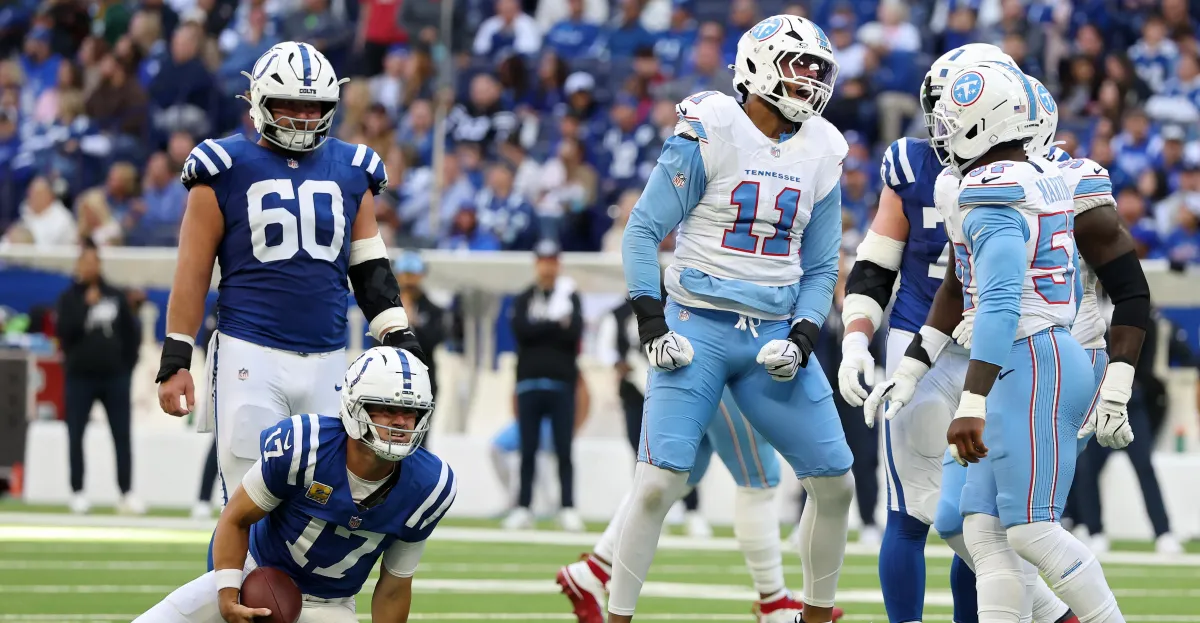
The Colts’ offense didn’t have much of a problem moving the ball downfield as they just held onto it. A 72.7% Drive Success rate can win you games but not if you give the ball to the opponent 3 times.
Daniel Jones was responsible for two of those turnovers, and his anemic second-half passing performance all but sealed the Colts’ fate. Let’s read the story from the numbers.
mouseover definitions:
arsr,
Edp,
sg%,
oz%,
pr%,
tip,
tht,
data,
is/c,
Yak,
Yacoe,
yd/c,
ac%,
cpoe,
that’s enough,
Dr,
scr%,
facing %,
sck%,
aa%,
the/d,
the/p,
1st percent,
td%,
in %,
qbsr,
epa/p,
adj/p
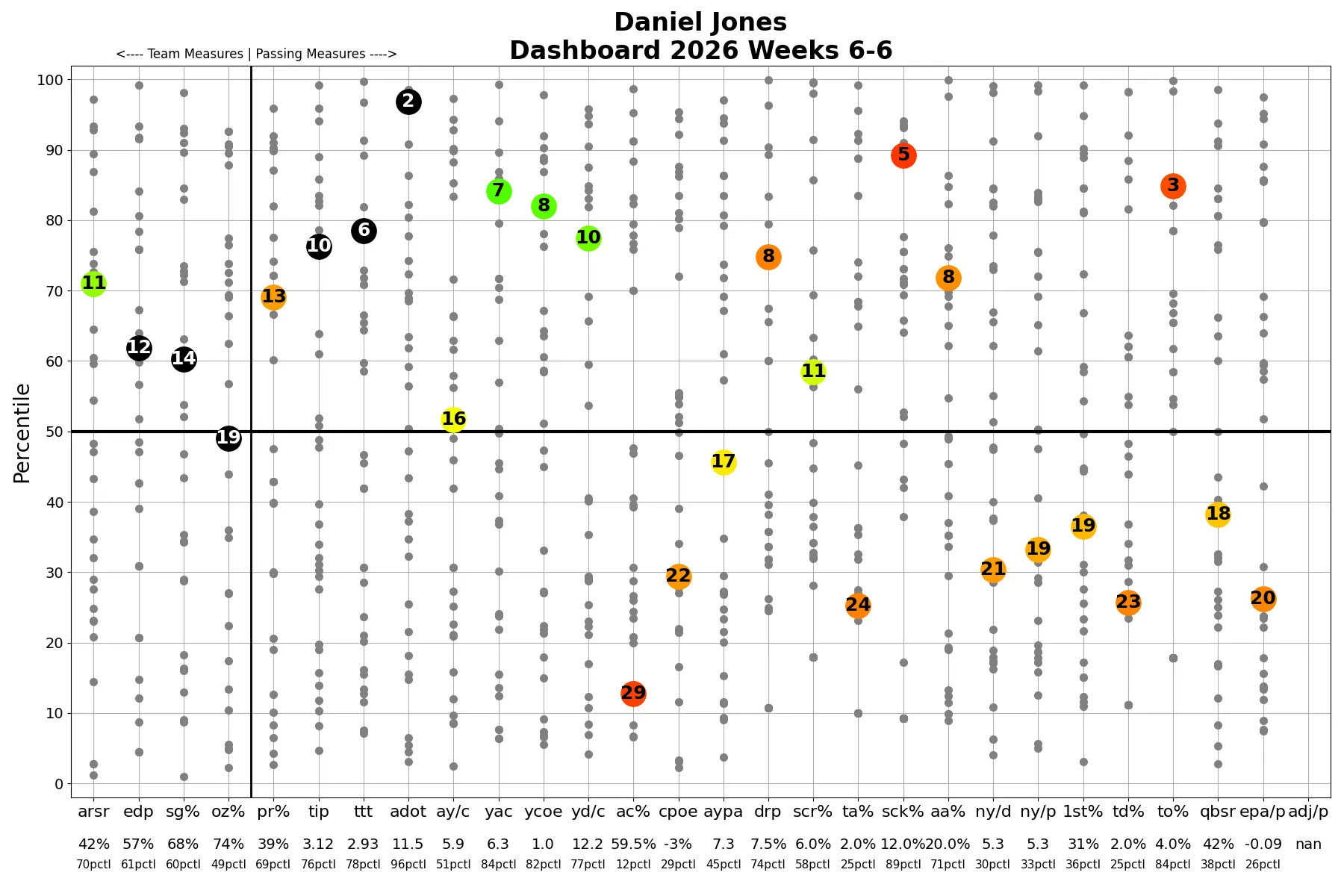
- Indianapolis got solid production from its running game while taking a fairly balanced approach on early downs. (11th ARSR; 12th EDP)
- Jones faced a fair amount of pressure but generally took longer than usual to get rid of the ball, meaning he invited a lot of pressure himself. (13th PR%; 10th TIP; 6th TTT)
- Jones attacked the downfield aggressively, throwing deeper than almost anyone in the league. However, he had trouble connecting and so his completions came in at a more ordinary depth. Fortunately, the receivers provide strong production after the catch that helps generate good overall yardage per completion. (2nd ADOT; 16th AY/C; 7th YAC; 8th YCOE; 10th YD/C)
- The big problem was that Jones struggled to complete passes consistently, finishing near the bottom of the league in converted completion rate. Completion yardage was offset, leaving his pass production per attempt below average. (29th AC%; 22nd CPOE; 17th AYPA)
- Drops are a big factor, but the biggest problem is sacks. He was sacked six times, which took away a huge amount of potential pass production. (8th DRP; 5th SCK%)
- Add in the throw-aways and scrambles and after all, he had a lot of abandoned passes. Those lost plays dragged down the passing game’s total yardage production, leaving Jones below average in net yards per dropback. (24th TA%, 11th SCR%, 8th AA%, 21st NY/D)
- With poor yardage, Jones was unable to generate first downs and managed just one touchdown. (19th 1ST%; 23rd TD%)
- Turnovers are particularly damaging. Jones threw two interceptions, both costly negative plays, giving him one of the highest turnover rates of the week. (4th TO%)
- He was below average in generating successful plays and the combination of sacks and two interceptions did not detract from his overall efficiency. (18th QBSR; 20th EPA/P)
mouseover definitions:
is,
dp%,
is/c,
Yak,
yd/c,
ac%,
that’s enough,
drp%,
that’s enough,
facing %,
especially,
sck%,
the/a,
scr%,
the/d,
car%,
the/p,
1st percent,
whatever,
td%,
whatever,
in %,
whatever,
epa/p,
Opd,
adj/p
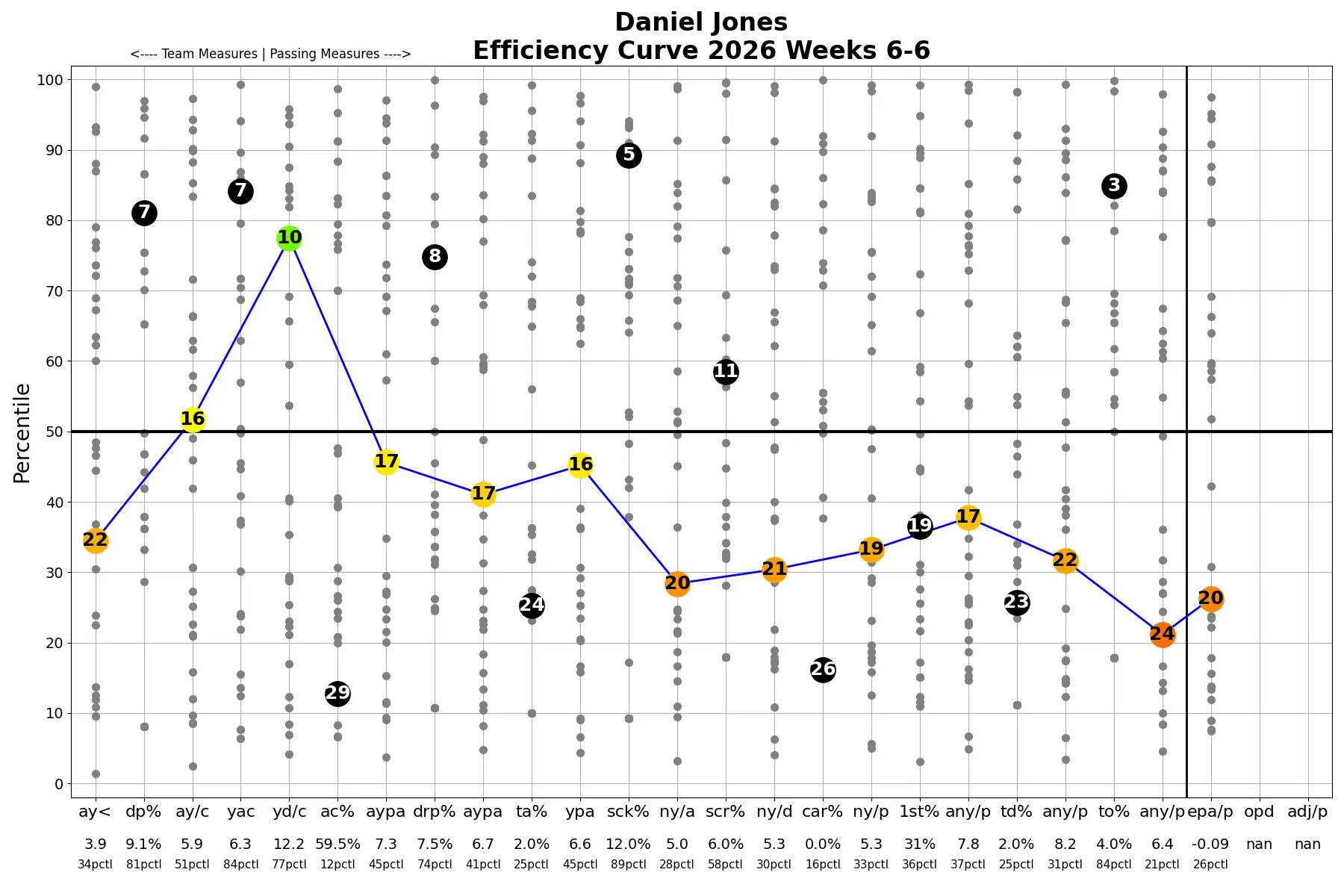
Jones has decent yardage efficiency on a per-completion basis, largely thanks to strong production after the catch. However, just like last week, his poor completion rate sent his overall yardage efficiency back below average. From there, his efficiency was mostly affected by sacks and turnovers, both of which caused significant declines.
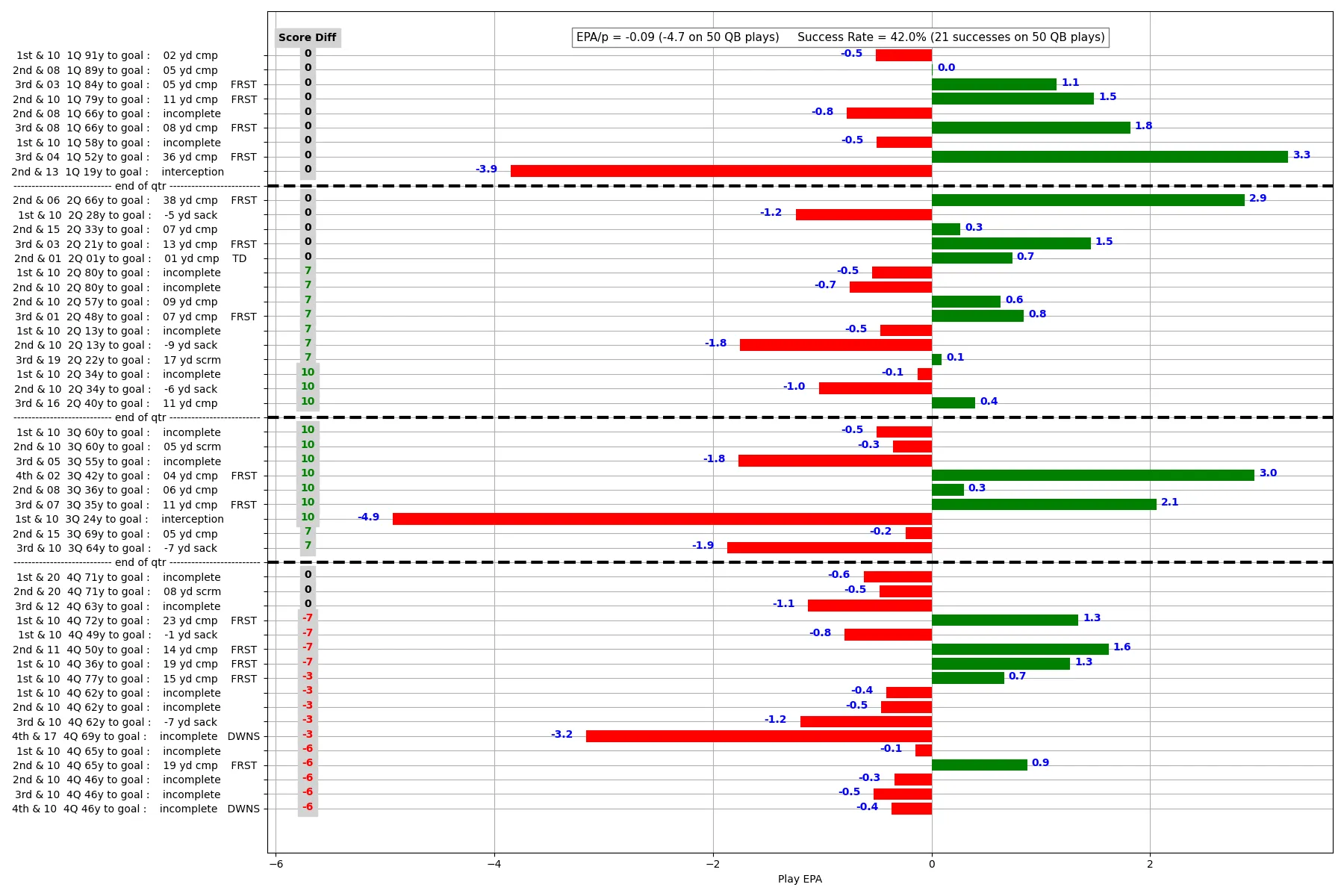
Jones started the game well, generating some positive plays before an interception erased much of that early production. He rebounded with some productive passes in the second quarter, including a touchdown, but his performance became increasingly inconsistent as the sacks and incompletions piled up. Overall, the costly negative plays outweighed his positive production, leaving him at -0.09 EPA per play.
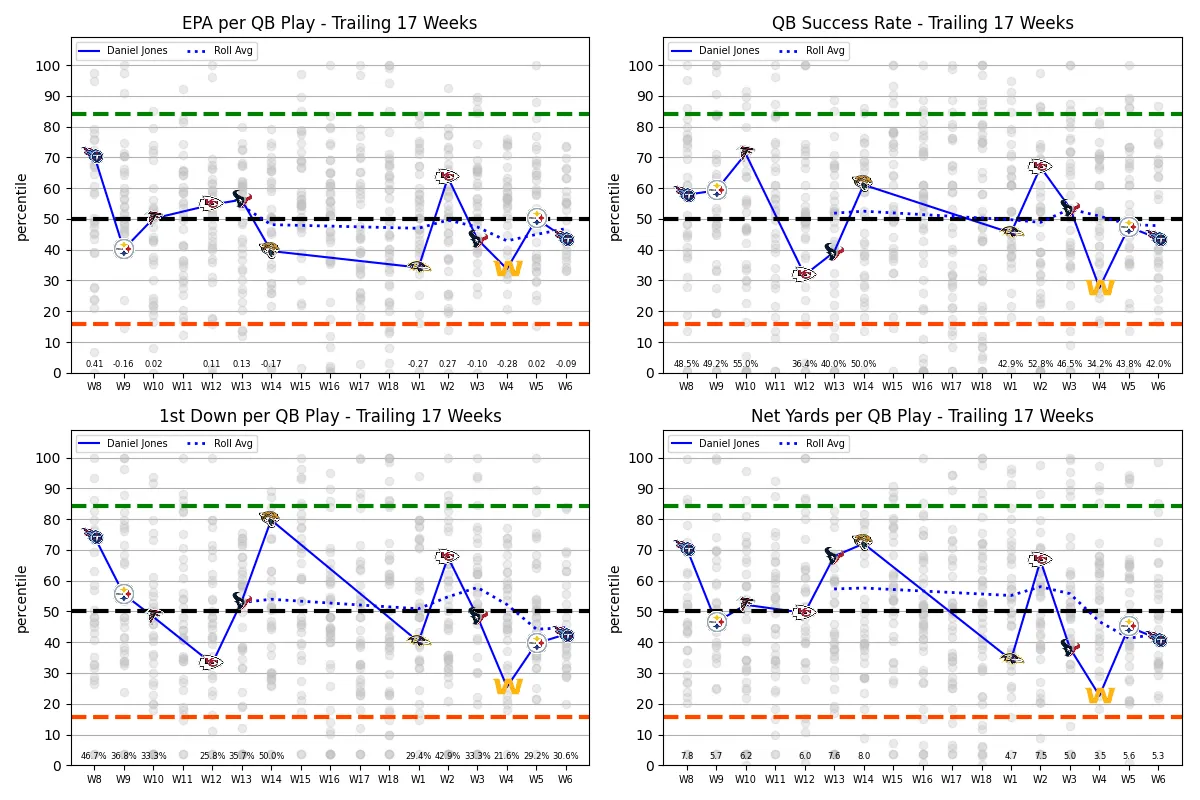
Jones is below average in all of the top 4 measurements. He is trending downward, with his performance becoming inconsistent. After a strong Week 2, his overall efficiency and yardage production dropped significantly, while his success rate and first-down production also slipped below average. Despite a modest rebound in Week 5, all four measures remain below the league average, suggesting a broader decline rather than a bad game.
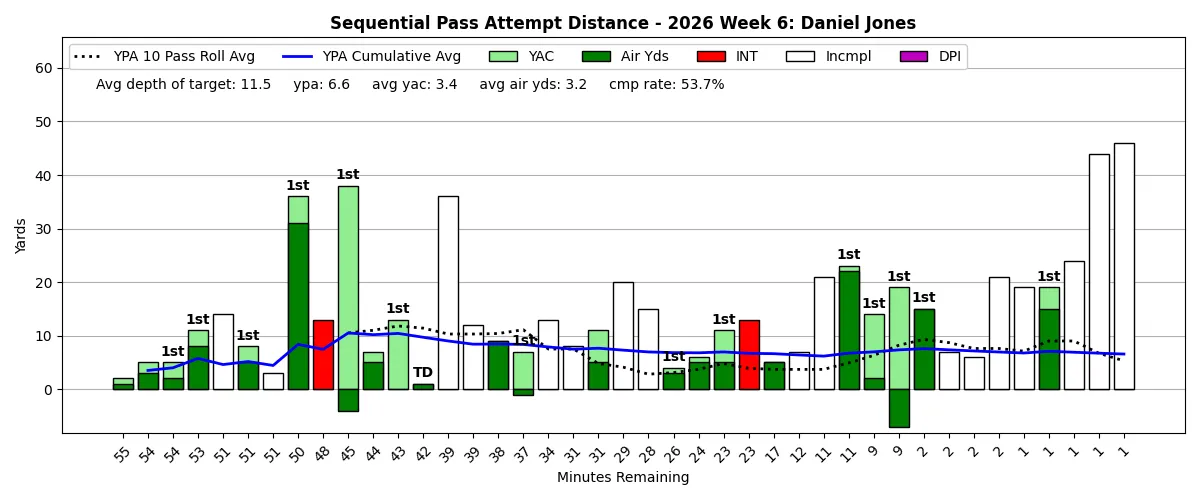
Jones started with some productive completions, but his passing became increasingly inconsistent, with two interceptions and frequent incompletions disrupting his rhythm. He had another productive stretch in the fourth quarter, but finished the game 1 for 8. His throws were generally aggressive downfield, averaging 11.5 yards beyond the line of scrimmage, but he completed just 53.7% of his passes (adjusted).

Again this week, passing was particularly aggressive, averaging 11.5 air yards per attempt. However, his completed passes came at a more ordinary depth, continuing between where he was targeting receivers and where he was actually completing passes.
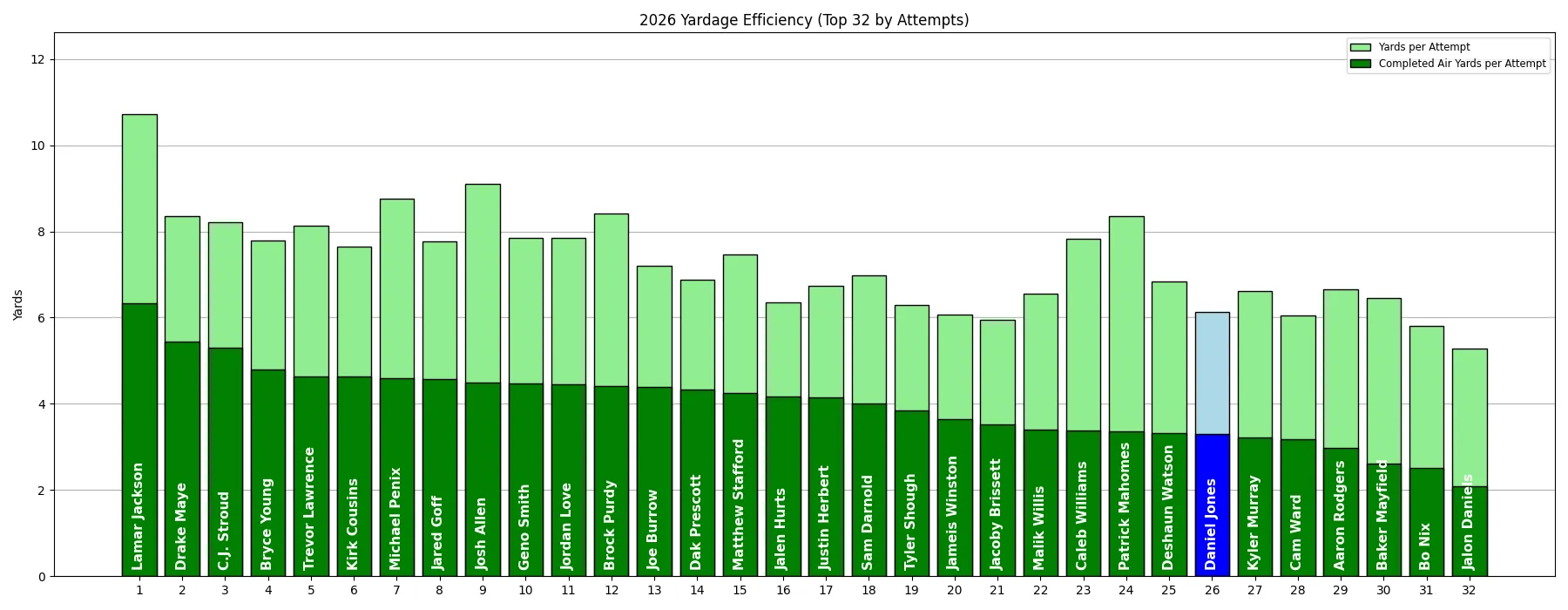
Jones has produced less than average yards per attempt this season, ranking 26th in the league oof the 7th shortest attempts.
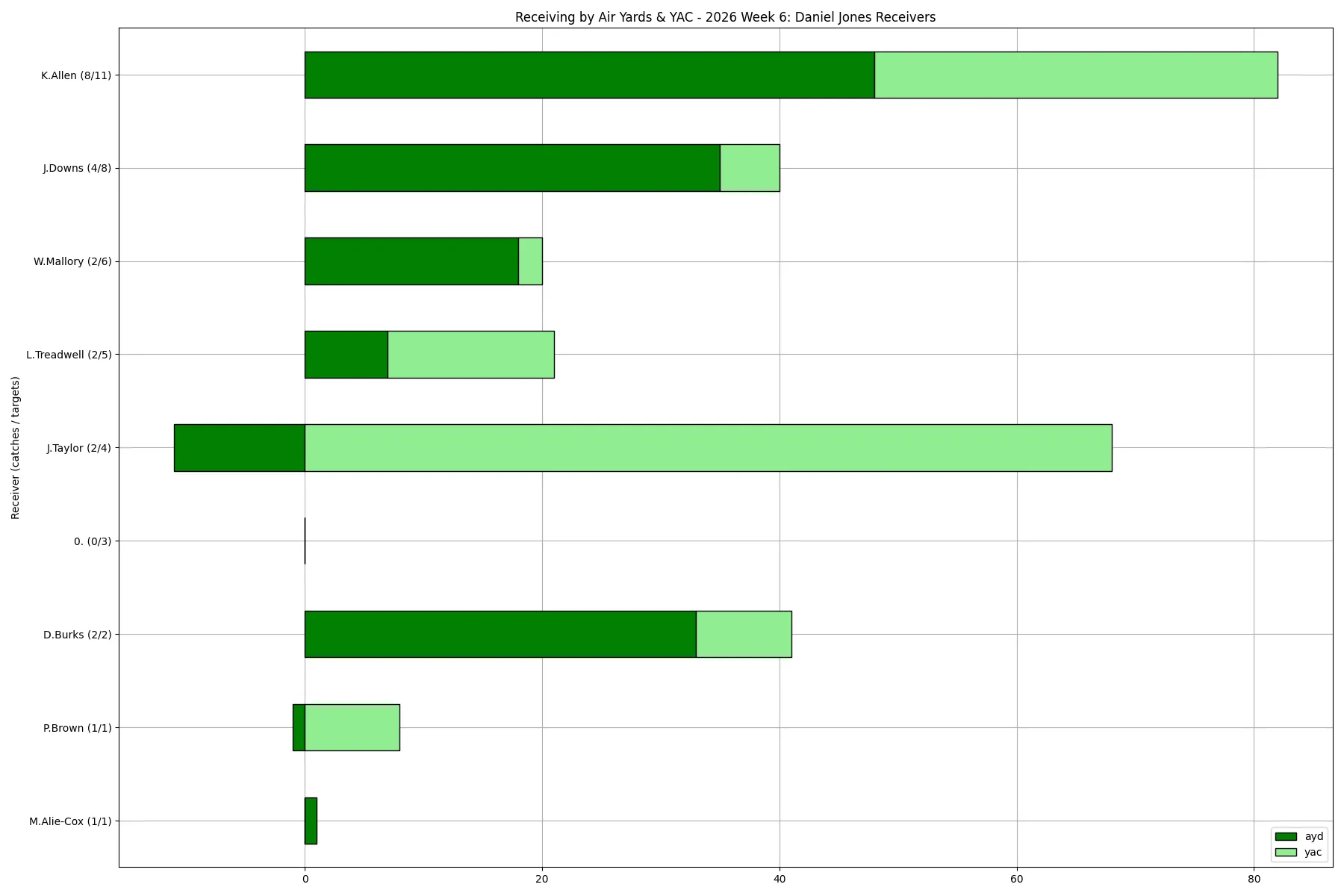
Keenan Allen led the Colts in receiving yards and air yards, catching 8 of 11 targets. Jonathan Taylor was the other major contributor in receiving yardage, with most of his production coming after the catch on just two receptions.
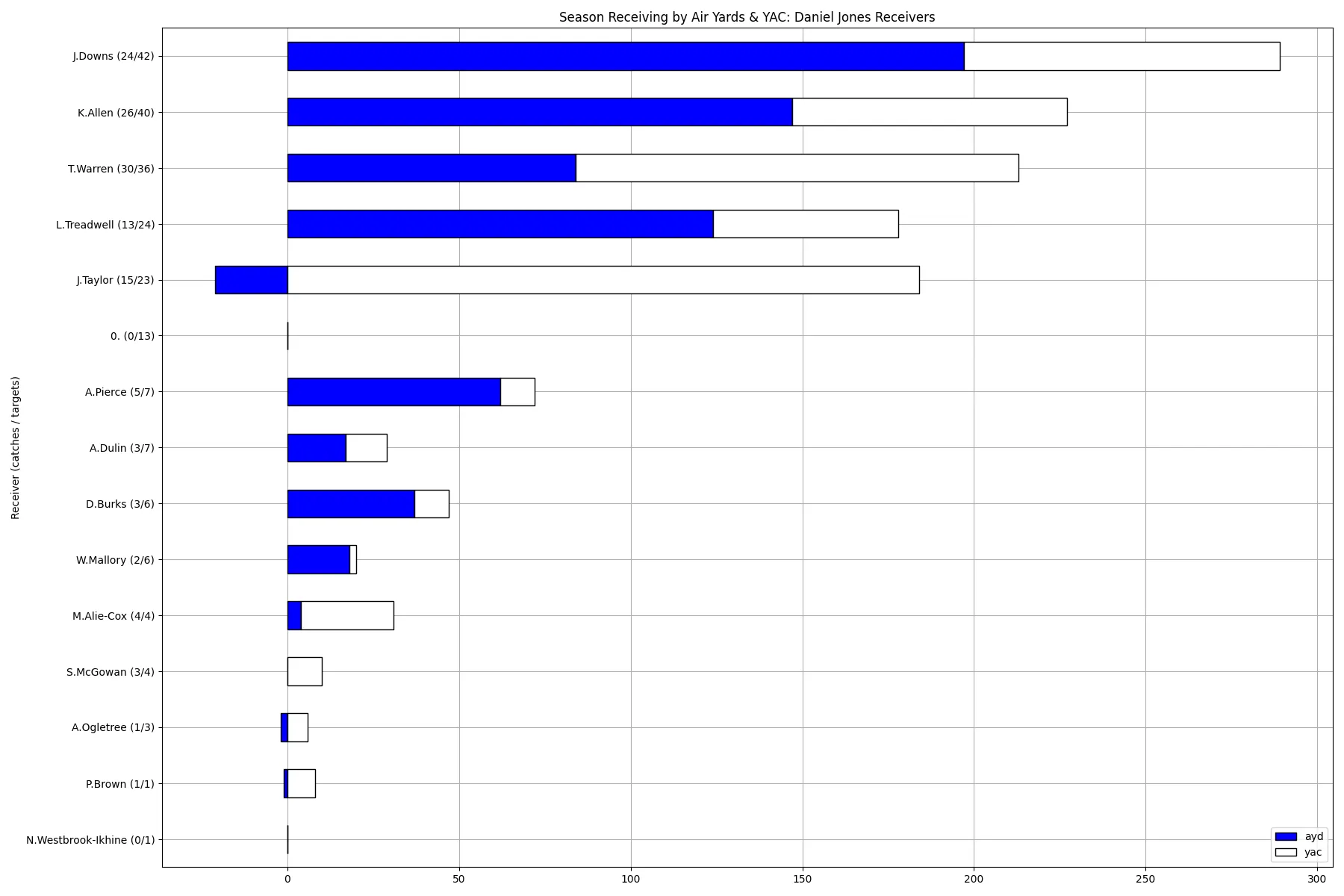
Josh Downs led the Colts in receiving yards, followed by Keenan Allen. Tyler Warren was a close 3rd with Jonathan Taylor beating out Treadwell for 4th place.
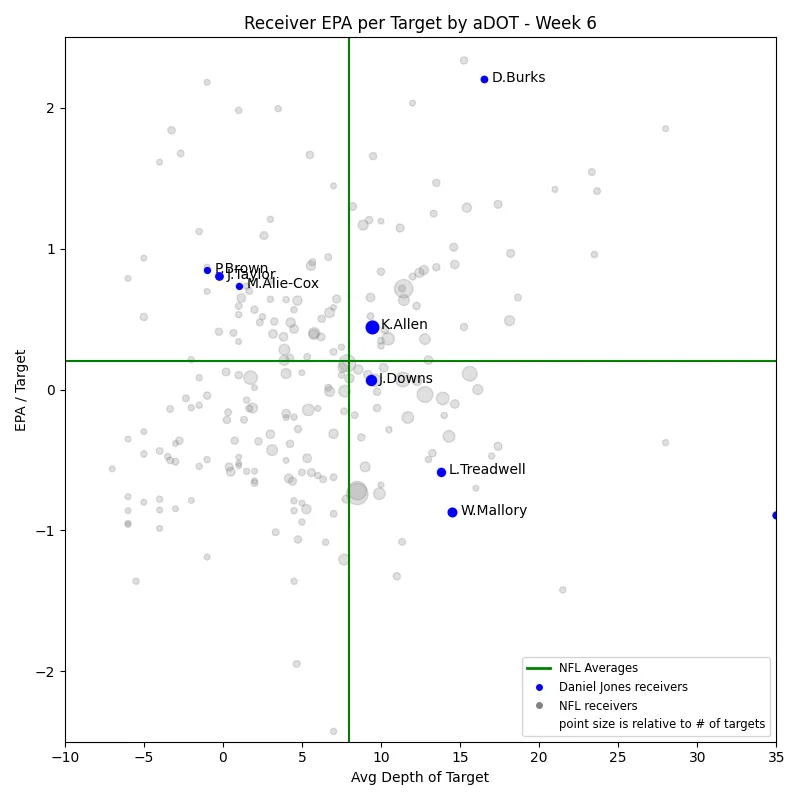
Keenan Allen is Jones’ most productive regular target, generating a positive EPA on relatively deep throws, while Josh Downs has just below average target value. Treadwell and Mallory have the deepest targets but below average value.
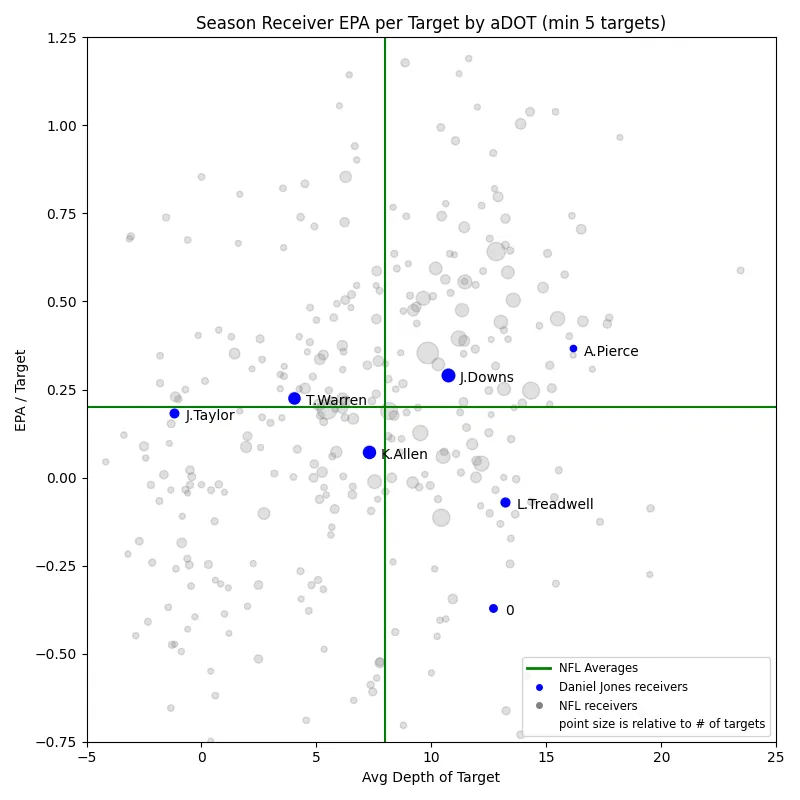
Josh Downs and Alec Pierce have been Jones’ best downfield targets this season, both generating an above-average EPA per target. Tyler Warren also provided solid value on shorter throws, while Jonathan Taylor was about average. Keenan Allen has been a disappointment relative to his target depth, generating very little positive EPA, while Laquon Treadwell is also on the team.
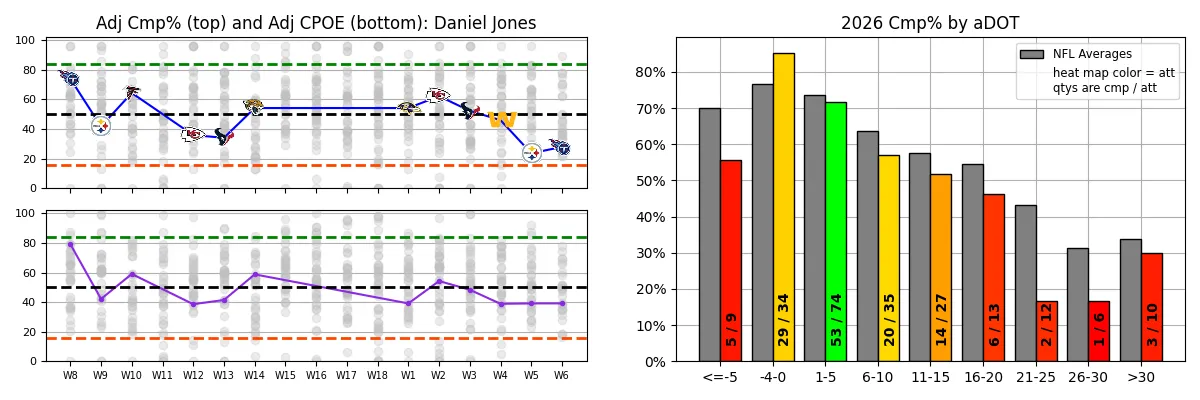
Jones’ completion rate has fallen sharply over the past two weeks, falling well below the league average along with his CPOE, which means his incompletions aren’t just because they’re long throws. On the season, he struggled at almost every depth, with the exception of screen passes.
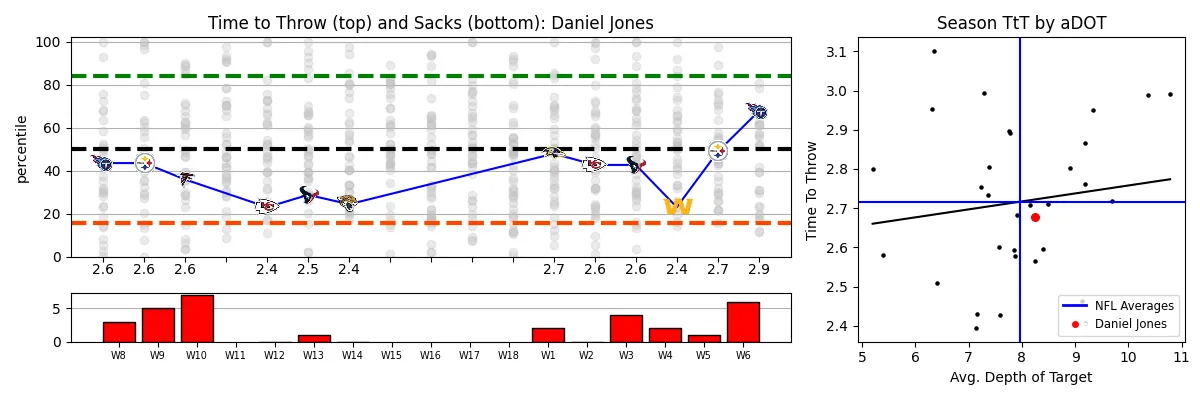
Jones took a little longer to throw this week, reversing the faster passing rhythm he had established over the past few games. However, his season-long throwing time is still below average for his target depth.
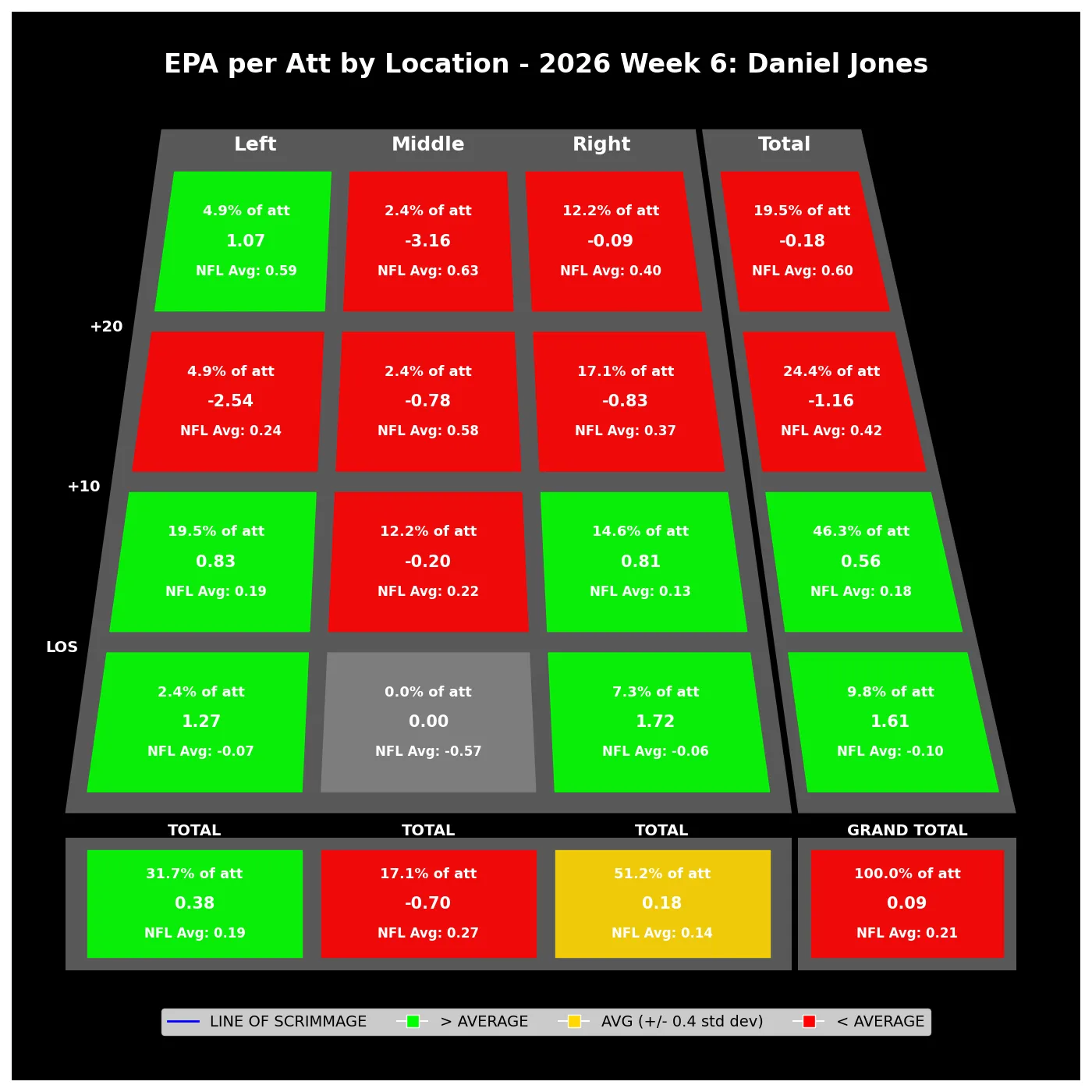
Within 10 yards, he did well. However, center bruises and deeper shots are a dumpster fire.
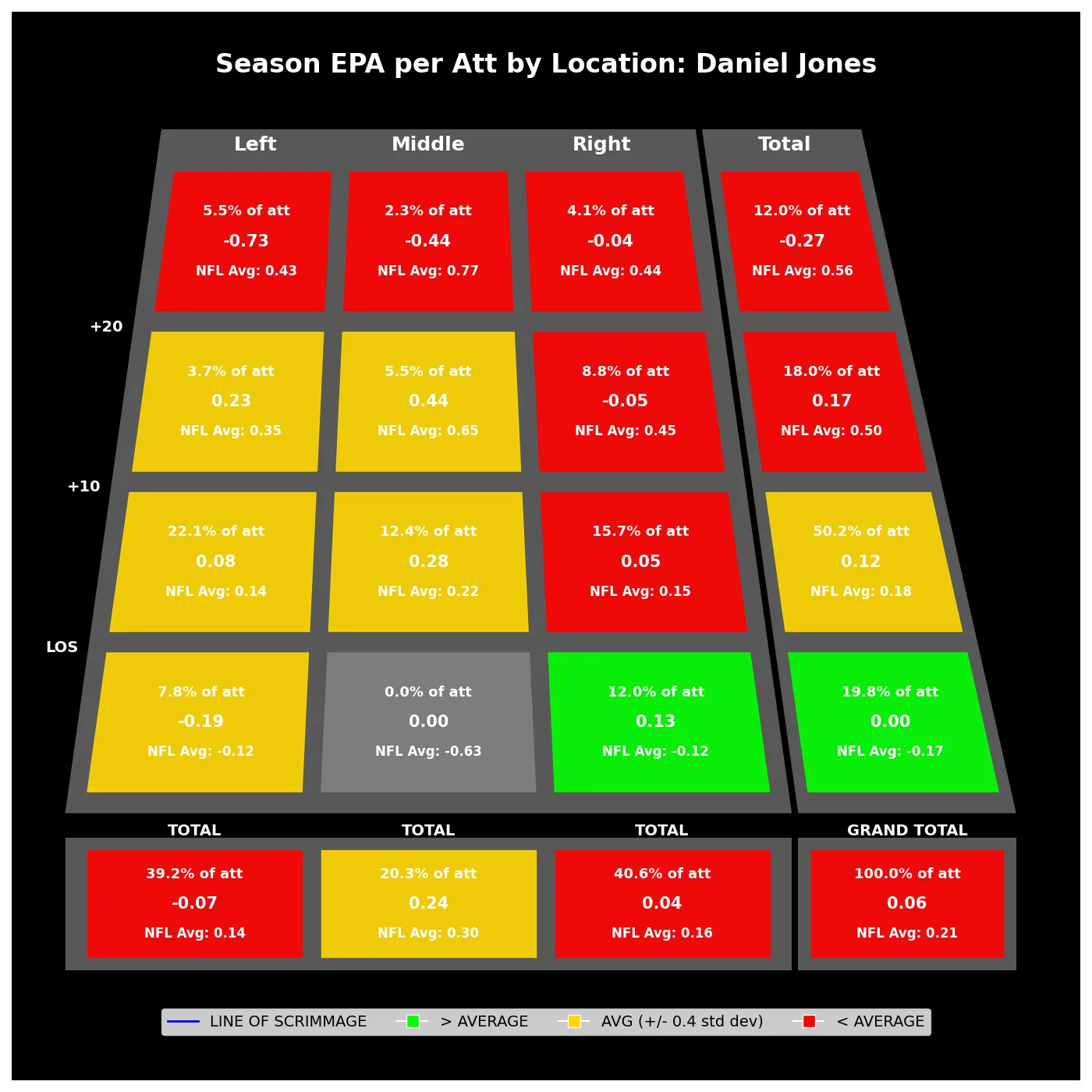
Jones has struggled to throw the ball downfield all season, with below-average efficiency at nearly every depth and in all areas of the field.