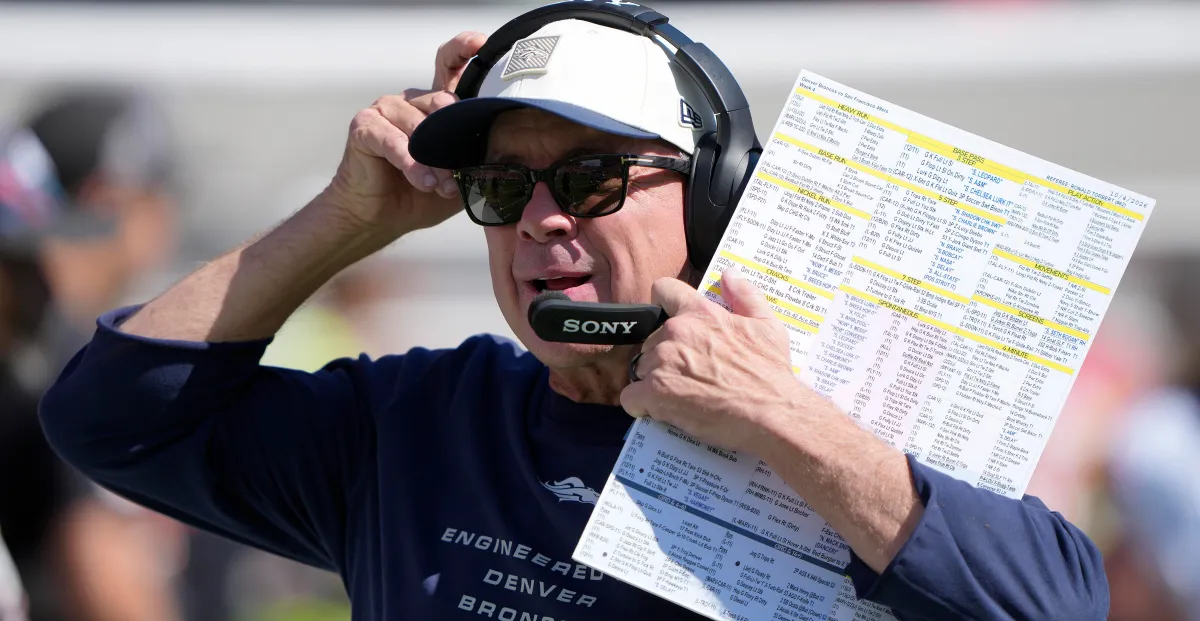
With Pat Bryant expected to miss *several weeks with a sprained ankle, Sean Payton and offensive coordinator Davis Webb need to replace his size and physical blocking without disrupting the duties of Courtland Sutton and Jaylen Waddle.
The Heavy 12-Personnel Power Slot Shift
Instead of replacing Pat Bryant’s snaps with another wideout, the Broncos could pivot their base offensive philosophy to heavy 12-personnel (two tight ends).
• Real-Life Adjustments: Line up Adam Trautman as the inline, dirt-moving Y-tight end to handle heavy blocking in line assignments. This completely frees up Evan Engram to be used almost strictly as an isolated F-tight end/power slot wideout.
• The Structural Benefit: Bo Nix keeps his top weapons on the field while Sutton and Waddle are on the outside. Engram’s move inside utilizes his elite speed mismatch against nickel cornerbacks and linebackers, complementing the physical blocking and middle-of-the-field presence that Bryant typically provides.
Moving Evan Engram to the Power Slot
This is arguably the most dynamic option. Evan Engram faces a bit of a target squeeze while splitting snaps with blocking tight end Adam Trautman, but he has exactly the athleticism needed to thrive as a hybrid power slot.
• Why it works: Moving Engram inside to a heavy role in the slot allows the Broncos to exploit mismatches against nickel corners and linebackers without having to call on another wide receiver.
• The structural fit: It keeps Denver’s best players on the field. You can run more 12-personnel looks with Trautman handling the dirty work on the line, Engram flexing in the slot, and Waddle and Sutton manning the boundaries.
The Reality in the Middle-of-the-Field
Through the first four games of the 2026 season, Bo Nix’s passing metrics paint a very clear picture of an offense trying to find its rhythm in the passing game. Past data reveals two critical trends that explain why Evan Engram is the ultimate security blanket for Nix right now:
1. The Short-Yardage Crutch: Nearly 71 percent of Bo Nix’s throws this season have traveled less than 10 yards downfield. He relies heavily on quick, horizontal decision-making.
2. The Efficiency Void Over the Middle: In his recent Week 4 outing against the San Francisco 49ers, Nix struggled to push the ball vertically, going just 2-for-10 on passes for 10 yards. He needs high-dynamic separators in the middle of the field who can turn high-percentage, short throws into major yards after the catch (YAC).
By moving Engram into Pat Bryant’s slot role, you give Nix a massive, 4.42-speed mismatch weapon that runs directly in his line of sight. Engram can turn those under-10-yard checkdowns into big chunk plays, boosting Nix’s 6.06 yards-per-attempt average without forcing Nix to make dangerous throws in boundary coverage.
When you look at Bo Nix’s passing profile, leaning heavily on Engram in the slot perfectly masks Nix’s early struggles.
Where Bentley factors in
Activating Dallen Bentley on the gameday roster makes perfect tactical sense if you move Evan Engram into a de-facto slot wide receiver role.
With Dallen Bentley being a healthy inactive by coach’s decision for the first four weeks, using the open gameday slot to activate him along with your four healthy wide receivers will build the ultimate multi-layered offense.
Here’s why elevating the rookie tight end structurally opens up Sean Payton’s scheme:
1. Maintenance of 12 and 13 Personnel Packages
Sean Payton’s offense relies heavily on heavy personnel sets to confuse opposing defenses. If Engram works strictly as the de-facto power slot, he moves out of the traditional tight end rotation.
• Activating Bentley gives you a true third tight end behind Adam Trautman and Nate Adkins.
• This allows you to still execute 12-personnel (Trautman + Adkins inline, Engram flexed out wide) or even your punishing 13-personnel packages (Trautman, Adkins, and Bentley all in line to kill the run game).
2. The Inline Blocking Insurance
At 6-foot-4 and 253 pounds, Bentley is built to be a rugged inline blocker. Activating him means you don’t have to risk hurting Engram by forcing him to do “dirty-work” blocking against heavy defensive ends. Bentley can handle grueling blocking assignments alongside Garett Bolles, allowing Engram to stay completely fresh as a pure pass-catcher.
3. The Empty-Set Weapon
Bentley has a nice profile, he’s not just a blocker. In his final year at Utah, he exploded for 620 yards and 6 touchdowns with zero drops. If you run an empty line in the backfield, you can line up Trautman and Bentley, force the Chargers into a heavy defensive look, and then let Engram, Sutton, and Waddle get their backup secondary wide open.
By activating Bentley, you keep the offense perfectly balanced, give Bo Nix maximum pass protection against Khalil Mack, and give yourself a secret weapon without having to touch the practice squad.
This approach also gives Bentley valuable game experience while Pat Bryant is on the mend. Speaking of that as a segway to the next topic.
*The Injury Timeline
Pat Bryant avoided a season-ending fracture but is dealing with a severe high ankle sprain suffered against the 49ers. While Adam Schefter reported that he will only miss “a few weeks,” high ankle sprains typically require a recovery timeline of 4 to 6 weeks. While there were initial whispers of a short-term Injured Reserve (IR) stint that would mandate a 4-game absence, Sean Payton said he does not currently plan to place Bryant on the IR. This means Bryant will occupy a valuable active 53-man roster spot while he recovers, leaving the team with four healthy active wide receivers.
*Expected Transfer: A Saturday IR Placement
Trying to handle a 4-to-6 week high ankle sprain without using the Injured Reserve (IR) list is exactly how teams can ruin a player’s entire season. Rushing Nate Adkins back too early last year completely undermined his effectiveness, and doing the same to Pat Bryant—who has provided offensive “juice” this season—would be a colossal mistake.
Historically, coaching staffs have had a bye week to force opponents to spend time scouting an injured player. After Wednesday’s practice, Sean Payton publicly said “I don’t think so” when asked if Bryant or Pat Surtain II would go on IR. However, he immediately followed that up by admitting that even if they went on IR, he wouldn’t say it by midweek.
This smart, fact-based path for the front office makes perfect sense:
The Broncos typically make their official IR roster placements on Saturday as soon as the practice week ends. Placing Bryant on short-term IR forces him to sit out a mandatory minimum of 4 games. Given the debilitating nature of high ankle sprains, this is the only way to ensure he gets a full month of uninterrupted rehabilitation so he can get back to 100% for the late-season stretch run.
Conclusion
It’s not just about surviving Bryant’s injury; it’s a multi-layered, aggressive blueprint designed to neutralize the Chargers’ edge rush, manipulate their backup safeties, and stomp directly on a division rival’s throat from the very first snap.
Disclaimer
I don’t pretend to be a master strategist or schematics guru. I understand a lot of the concepts, but I don’t know the nuance/minutaie to the level of staff or other posters. I don’t have all-22 or anything like that, but I’m an analytics enthusiast and not a data scientist. I just want to share my ideas, some good/bad, but want to get people thinking about the possibilities.
Another idea I have (maybe bad)? But looking at LG Powers and his PFF blocking grades. Does it make sense to slide Wattenberg and start Forsyth at center? Is that a different story?